<p style="font-size:125%"><b>J. Robert Oppenheimer (1904 - 1967) was the head of the Los Alamos Laboratory during World War II and is credited with being the father of the atomic bomb.</b></p>
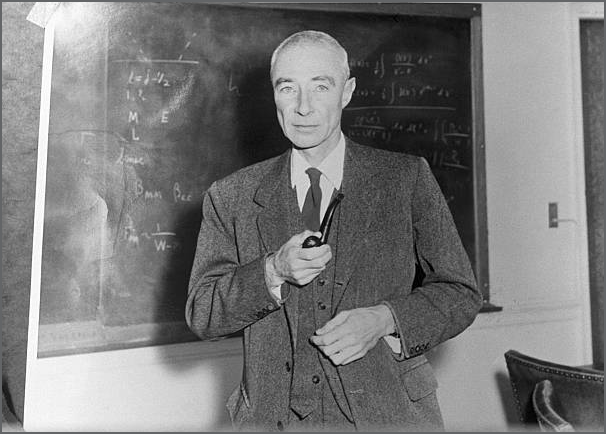
# Overview of J. Robert Oppenheimer
| Biography | Details |
|:---:|:---:|
| Full Name: | Julius Robert Oppenheimer |
| Date of Birth: | 04-22-1904 |
| Date of Death: | 02-18-1967 |
| Gender: | Male |
| Nationality: | American |
| Religion: | |
| Political Party: | |
| Relationship | Name |
|:---:|:---:|
| | |
| School | Degree | Timeline |
|:---:|:---:|:---:|
| | | |
| Employmer | Role | Timeline |
|:---:|:---:|:-: |
| | | |
## Biographies for J. Robert Oppenheimer
> [!column|no-t flex bg-c-green]+
>
> > [!info|no-icon bg-c-blue c-gray]- **Wikipedia Profile** <br><sub> - *Click to Expand* → </sub>
> > **Overview**
> >
> > Julius Robert Oppenheimer was an American theoretical physicist and director of the Los Alamos Laboratory during World War II. He is often credited as the "father of the atomic bomb" for his role in organizing the Manhattan Project, the research and development undertaking that created the first nuclear weapons.
> >
> > Born to German [[Judaism|Jewish]] immigrants in New York City, Oppenheimer earned a bachelor's degree in chemistry from Harvard University in 1925 and a PhD in physics from the University of Göttingen in Germany in 1927. After research at other institutions, he joined the physics department at the University of California, Berkeley, where he became a full professor in 1936. He made significant contributions to theoretical physics, including achievements in quantum mechanics and nuclear physics such as the Born–Oppenheimer approximation for molecular wave functions, work on the theory of electrons and positrons, the Oppenheimer–Phillips process in nuclear fusion, and the first prediction of quantum tunneling. With his students, he also made contributions to the theory of neutron stars and black holes, quantum field theory, and the interactions of cosmic rays.
> >
> > In 1942, Oppenheimer was recruited to work on the Manhattan Project, and in 1943 was appointed director of the project's Los Alamos Laboratory in New Mexico, tasked with developing the first nuclear weapons, four years after the start of the German nuclear weapons program. His leadership and scientific expertise were instrumental in the project's success. On July 16, 1945, he was present at the first test of the atomic bomb, Trinity. In August 1945, the weapons were used against Japan in the bombings of Hiroshima and Nagasaki, which remain the only use of nuclear weapons in an armed conflict.
> >
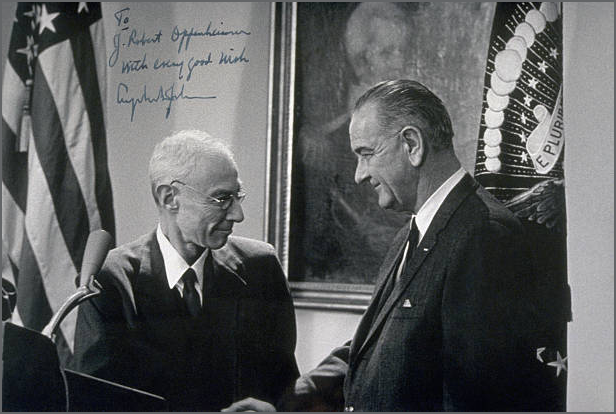
> > In 1947, Oppenheimer became the director of the Institute for Advanced Study in Princeton, New Jersey, and chaired the influential General Advisory Committee of the newly created United States Atomic Energy Commission. He lobbied for international control of nuclear power, to avert nuclear proliferation and a nuclear arms race with the Soviet Union. He opposed the development of the hydrogen bomb during a 1949–1950 governmental debate on the question, and subsequently took positions on defense-related issues that provoked the ire of some U.S. government and military factions. During the Second Red Scare, Oppenheimer's stances, together with past associations he had with people and organizations affiliated with the Communist Party USA, led to the revocation of his security clearance following a 1954 security hearing. Effectively stripped of his direct political influence, he continued to lecture, write, and work in physics. In 1963, President John F. Kennedy awarded him (and Lyndon B. Johnson presented him with) the Enrico Fermi Award as a gesture of political rehabilitation. In 2022, the U.S. government vacated its 1954 decision, saying that the process had been flawed.[^1]
Oppenheimer observed the Trinity test, where the first atomic bomb was successfully detonated, and later remarked that the explosion brought to mind the Bhagavad Gita.
After the war, Oppenheimer became chairman of the General Advisory Committee of the newly created United States Atomic Energy Commission, and lobbied against the development of the hydrogen bomb and other defense-related issues. He was stripped of his security clearance in 1954.
Oppenheimer's achievements in physics include the Born - Oppenheimer approximation for molecular wave functions, the Oppenheimer - Phillips process in nuclear fusion, and the first prediction of quantum tunneling.
### Childhood and Education
J. Robert Oppenheimer was born in [New York](https://www.wikiwand.com/en/NewYork(state) "New York (state)") City on April 22, 1904, to a painter and a wealthy textile importer. He became a physicist and had a younger brother, Frank, who also became a physicist.
Oppenheimer was initially educated at Alcuin Preparatory School, but entered the Ethical Culture Society School in 1911 and skipped half of the eighth grade. He then entered Harvard College one year after graduation, but suffered an attack of colitis while prospecting in Europe.
Oppenheimer majored in chemistry, but took six courses per term and was admitted to the undergraduate honor society Phi Beta Kappa. He graduated summa cum laude in three years.
### Studies in Europe
In 1924, Oppenheimer was accepted into Christ's College, Cambridge, but his tutor Patrick Blackett was unimpressed and considered placing him on probation. Oppenheimer's parents successfully lobbied the authorities to prevent this.
In 1926, Oppenheimer left Cambridge for the University of Göttingen to study under Max Born. He made friends who went on to great success, including Werner Heisenberg, Pascual Jordan, Wolfgang Pauli, Paul Dirac, Enrico Fermi and Edward Teller.
### Educational Work
Oppenheimer was awarded a fellowship by the United States National Research Council to the California Institute of Technology, but split his fellowship with Harvard. He struck up a close friendship with Linus Pauling, but their friendship ended when Pauling suspected Oppenheimer of becoming too close to his wife.
In 1928, Oppenheimer visited Paul Ehrenfest's institute at the University of Leiden, the Netherlands, and was given the nickname of Opje. He later worked with Wolfgang Pauli at the Swiss Federal Institute of Technology in Zurich.
Oppenheimer returned to the United States and accepted an associate professorship at the University of California, Berkeley. He was admired for his intellectual virtuosity and broad interests, but was also seen as a pretentious and insecure poseur.
He worked closely with Nobel Prize-winning experimental physicist Ernest O. Lawrence and his cyclotron pioneers, and was promoted to full professor in 1936.
### Scientific Work
Oppenheimer did important research in theoretical astronomy, nuclear physics, spectros, and quantum field theory. He doubted the validity of relativistic quantum mechanics.
Initially, his major interest was the theory of the continuous spectrum, but he also calculated the photoelectric effect for hydrogen and X-rays, obtaining the absorption coefficient at the K-edge.
Oppenheimer made important contributions to the theory of cosmic ray showers and quantum tunneling, and disputed Dirac's assertion that two energy levels of the hydrogen atom have the same energy.
Oppenheimer worked with Melba Phillips on calculations of artificial radioactivity under bombardment by deuterons. They came up with a theory that still is used today.
In 1930, Oppenheimer predicted the existence of the positron, but rejected the idea that positively charged electrons were protons. Two years later, Carl David Anderson discovered the positron.
In the late 1930s, Oppenheimer became interested in astrophysics through his friendship with Richard Tolman, and produced a series of papers that were key factors in the rejuvenation of astrophysical research in the United States in the 1950s.
Oppenheimer's papers were considered difficult to understand, and he was sometimes criticized for making mathematical mistakes.
Oppenheimer's diverse interests sometimes interrupted his focus on science, and he developed an interest in the mystical and the cryptic. He read the Bhagavad Gita and the Upanishads in the original Sanskrit, and deeply pondered over them.
Oppenheimer was nominated for the Nobel Prize in physics three times, but never won, for his work on gravitational contraction, concerning neutron stars and black holes.
### Private and Political Life
During the 1920s, Oppenheimer remained uninformed on worldly matters and never cast a vote. However, he became increasingly concerned about politics and international affairs and earmarked three percent of his annual salary to support German physicists fleeing from Nazi Germany.
Oppenheimer's mother died in 1931, and he became closer to his father who became a frequent visitor in California. Oppenheimer supported social reforms that were later alleged to be communist ideas, and he donated to many progressive causes that were later branded as left-wing during the McCarthy era.
Oppenheimer met Katherine Puening, a radical Berkeley student and former Communist Party member, in August 1939. They created a minor scandal by sleeping together after one of Tolman's parties, and Kitty took Oppenheimer as her fourth husband in November 1940.
The [[FBI]] opened a file on Oppenheimer in March 1941, and noted that he attended a meeting at Chevalier's home in December 1940 that was also attended by the Communist Party's California state secretary William Schneiderman, and its treasurer Isaac Folkoff.
Oppenheimer was under investigation by the FBI and the Manhattan Project's internal security arm for left-wing associations. His former girlfriend committed suicide in 1944.
In August 1943, Oppenheimer volunteered to Manhattan Project security agents that George Eltenton had solicited three men at Los Alamos for nuclear secrets on behalf of the Soviet Union.
### Los Alamos
On October 9, 1941, President Franklin D. Roosevelt approved a crash program to develop an atomic bomb. In May 1942, Robert Oppenheimer took over work on fast neutron calculations, and hosted a summer school for bomb theory at his building in Berkeley.
The US Army established the Manhattan Project in June 1942 to handle its part in the atom bomb project. Groves selected Oppenheimer to head the project's secret weapons laboratory, and was impressed by his singular grasp of the practical aspects of designing and constructing an atomic bomb.
Oppenheimer and Groves decided that a centralized, secret research laboratory in a remote location was needed. They scouted for a site in late 1942 and eventually built the Los Alamos Laboratory on the site of a private boys' school.
Oppenheimer was initially supposed to be a military scientist, but the project grew so large that he was made director of the laboratory. He was noted for his mastery of all scientific aspects of the project and for his efforts to control the inevitable cultural conflicts between scientists and the military.
At this point in the war, there was considerable anxiety among the scientists that the Germans might be making faster progress on an atomic weapon than they were.
In 1943, Oppenheimer developed a plutonium gun-type fission weapon called "[Thin Man](https://www.wikiwand.com/en/ThinMan(nuclear_bomb) "Thin Man (nuclear bomb)")", but when he received the first sample of plutonium from the X-10 Graphite Reactor, he abandoned the gun design in favor of an implosion-type weapon.
In May 1945, an Interim Committee was created to advise on wartime and postwar policies regarding the use of nuclear energy. A scientific panel was established to advise on scientific issues.
### Trinity
The joint work of the scientists at Los Alamos resulted in the world's first nuclear explosion, near Alamogordo, New Mexico, on July 16, 1945.
Oppenheimer named the test site "Trinity" after a line from John Donne's Holy Sonnets, and expressed his hopes and fears in a quotation from the Bhagavad Gita.
Years later, he would explain that another verse had entered his head at that time: "I am become Death, the destroyer of worlds".
Physicist Isidor Rabi noticed Oppenheimer's disconcerting triumphalism: "I'll never forget his walk; I'll never forget the way he stepped out of the car … his walk was like High Noon … this kind of strut. He had done it. "
On the evening of August 6, 1945, Oppenheimer took to the stage at Los Alamos and clasped his hands together "like a prize-winning boxer" while the crowd cheered. He regretted that the weapon had not been available in time to use against Nazi Germany.
### Postwar Activities
After the bombings of Hiroshima and Nagasaki, Oppenheimer became a national spokesman for science and a household name. He felt that the [[United Nations]] could stifle a nuclear arms race.
### Institute for Advanced Study
Oppenheimer left Los Alamos in 1945 and moved to Princeton, New Jersey, where he took up the directorship of the Institute for Advanced Study. He collected European furniture and French post-impressionist and Fauvist artworks.
Oppenheimer brought together intellectuals from a variety of disciplines to answer the most pertinent questions of the age, including Freeman Dyson and Chen Ning Yang and Tsung-Dao Lee, who won a Nobel Prize for their discovery of [parity](https://www.wikiwand.com/en/Parity_(physics) "Parity (physics)") non-conservation.
Physicists tackled the greatest outstanding problem of the pre-war years, and Robert Marshak's innovative two-meson hypothesis led to Cecil Frank Powell's breakthrough and subsequent Nobel Prize for the discovery of the pion.
### Atomic Energy Commission
As a member of a committee appointed by Truman, Oppenheimer strongly influenced the Acheson - Lilienthal Report, which advocated the creation of an international Atomic Development Authority. Oppenheimer saw this as an attempt to maintain the United States' nuclear monopoly.
After the Atomic Energy Commission was created in 1947, Oppenheimer was appointed as the Chairman of its General Advisory Committee. He lobbied for international arms control and funding for basic science.
The first atomic bomb test by the Soviet Union in August 1949 sparked a debate within the U.S. government, military, and scientific communities regarding whether to proceed with the development of a far more powerful, nuclear fusion-based hydrogen bomb.
In October 1949, Oppenheimer and the GAC recommended against the development of the Super, because they felt that such a weapon could only be strategically used, resulting in millions of deaths. They also had practical qualms regarding the development of a hydrogen bomb.
In 1951, Edward Teller and Stanislaw Ulam developed a hydrogen bomb design that was technically feasible.
Oppener, Conant and Lee DuBridge left the GAC when their terms expired, as President Truman wanted new voices on the committee.
### Panels and Study Groups
Oppenheimer played a role in several government panels and study projects during the late 1940s and early 1950s, including the Long-Range Objectives Panel and Project GABRIEL.
Oppenheimer participated in Project Charles and Project East River, which led to Project Lincoln, which led to the building of the Distant Early Warning Line. This led to a debate about whether Oppenheimer and other scientists, or the Air Force, was embracing an inflexible "Maginot Line" philosophy.
Project Vista looked at improving U.S. tactical warfare capabilities, but Oppenheimer's chapter challenged the doctrine of strategic bombardment and advocated for smaller tactical nuclear weapons. The Air Force suppressed the report.
Oppenheimer chaired a panel that urged the United States to postpone its first hydrogen bomb test and seek a thermonuclear test ban with the Soviet Union, but its recommendations were not adopted. Oppenheimer subsequently presented his view on the lack of utility of ever-larger nuclear arsenals to the American public.
By 1953, Oppenheimer had become influential in multiple government posts and projects, but his opposition to the H-bomb made him the enemy of the proponents of strategic bombardment.
### Security Hearing
The FBI had been following Oppenheimer since before the war, and had bugged his home and office, tapped his phone and opened his mail.
The FBI furnished Oppenheimer's political enemies with evidence that implicated Communist ties. These enemies included Strauss, who had long harbored resentment against Oppenheimer.
Frank Oppenheimer was fired from his University of Minnesota position after he testified before the House Un-American Activities Committee. He later became a cattle rancher in Colorado and the founder of the San Francisco Exploratorium.
The US government held a security hearing into J. Robert Oppenheimer's past Communist ties and his association during the Manhattan Project with suspected disloyal or Communist scientists. The hearing was published in June 1954 with some redactions.
Oppenheimer confessed he had fabricated a story about Eltenton's approach to various Los Alamos scientists to protect his friend Haakon Chevalier, but both Eltenton and Chevalier denied any thought or suggestion of treason or thoughts of espionage.
The scientific community was outraged by Teller's testimony, and Oppenheimer's clearance was stripped one day before it was due to lapse anyway. Oppenheimer was seen by most of the scientific community as a martyr to McCarthyism.
Oppenheimer was never involved in espionage for the Soviet Union, and had several persons removed from the Manhattan Project who had sympathies to the Soviet Union. He was also a concealed member of the CPUSA.
### Final Years and Death
Oppenheimer spent several months of the year on the island of Saint John in the U.S. Virgin Islands, where he built a spartan home.
Oppenheimer's first public appearance following the stripping of his security clearance was a lecture for the [[Columbia University]] Bicentennial radio show Man's Right to Knowledge.
The University of Washington president cancelled Oppenheimer's invitation to deliver a series of lectures there, but the decision was overturned by the university senate. Oppenheimer never lectured at the University of Washington.
Oppenheimer was increasingly concerned about the potential danger that scientific inventions could pose to humanity. He did not sign the major open protests against nuclear weapons of the 1950s.
Oppenheimer stressed the importance of knowledge in a world where the freedom of science to exchange ideas is increasingly hobbled by political concerns. He rejected the idea of nuclear gunboat diplomacy.
In 1957, Oppenheimer was invited to deliver the William James Lectures at Harvard University. A group of alumni protested against the invitation.
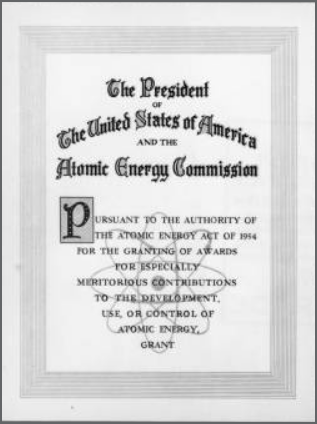
Deprived of political power, Oppenheimer continued to lecture, write and work on physics, and was awarded the Enrico Fermi Award by President Kennedy in 1963 as a gesture of political rehabilitation.
Oppenheimer was awarded the Congressional Medal of Honor, which came with a $50,000 tax-free stipend, and was outraged by many prominent Republicans in Congress.
Oppenheimer was diagnosed with throat cancer in late 1965, underwent unsuccessful radiation treatment and chemotherapy in late 1966, and fell into a coma on February 15, 1967. He died a week later, and his ashes were placed into an urn and placed in the sea near his beach house.
In 1972, Kitty Oppenheimer died at age 62, leaving her ranch in New Mexico to her son Peter and the beach property to her daughter Toni. Toni committed suicide in 1977, leaving the property to the people of St. John.
### Legacy
When Oppenheimer was stripped of his political influence in 1954, it symbolized the folly of scientists thinking they could control how others would use their research. It also reflected a stark divide in the nuclear weapons community.
The H-bomb was developed by the Manhattan Project, but a group of scientists felt that it would not improve the Western security position and that using the weapon against large civilian populations would be an act of genocide.
Popular depictions of Oppenheimer portray him as a confrontation between right-wing militarists and left-wing intellectuals over the moral question of weapons of mass destruction.
Heinar Kipphardt's play In the Matter of J. Robert Oppenheimer was a partisan play that sided with Oppenheimer but portrayed him as a "tragic fool and genius". Oppenheimer threatened to sue the playwright after reading a transcript.
In addition to his use by authors of fiction, there are numerous biographies, including American Prometheus: The Triumph and Tragedy of J. Robert Oppenheimer (2005) by Kai Bird and Martin J. Sherwin which won the Pulitzer Prize for Biography or Autobiography for 2006.[262]
The Oppenheimer story has often been viewed as a modern tragedy, with charm and arrogance, intelligence and blindness, awareness and insensitivity, and perhaps above all daring and fatalism being turned against him in the hearings.
[Oppenheimer](https://www.wikiwand.com/en/Oppenheimer(crater) "Oppenheimer (crater)") was a brilliant researcher and engaging teacher who founded modern theoretical physics in the United States. He never worked long enough on any one topic to merit the Nobel Prize.
An asteroid, 67085 Oppenheimer, was named in his honor,[270] as was the lunar crater Oppenheimer.[271]
Oppenheimer was a [technocratic](https://www.wikiwand.com/en/Technocracy(bureaucratic) "Technocracy (bureaucratic)") leader in a shift in the interactions between science and the military and the emergence of "Big Science".
## Image Gallery
> [!grid|masonry]
> 
> 
> 
>
> 
> 
>
> 
> 
> 
[Getty Images](https://www.gettyimages.com/photos/robert-oppenheimer?family=editorial&assettype=image&phrase=Robert%20Oppenheimer)
%%Footer Starts Here%%
---
---
# Keep Digging
**Related:** •
## Tags
#Index/Person
### Footnotes & References
[J. Robert Oppenheimer - Wikiwand](https://www.wikiwand.com/en/J._Robert_Oppenheimer)
[^1]: Overview of Robert Oppenheimer pulled from **[Wikipedia](https://en.wikipedia.org/wiki/Robert_Oppenheimer)** on [[07-22-2023]].