## Newspaper Articles
### April 1987
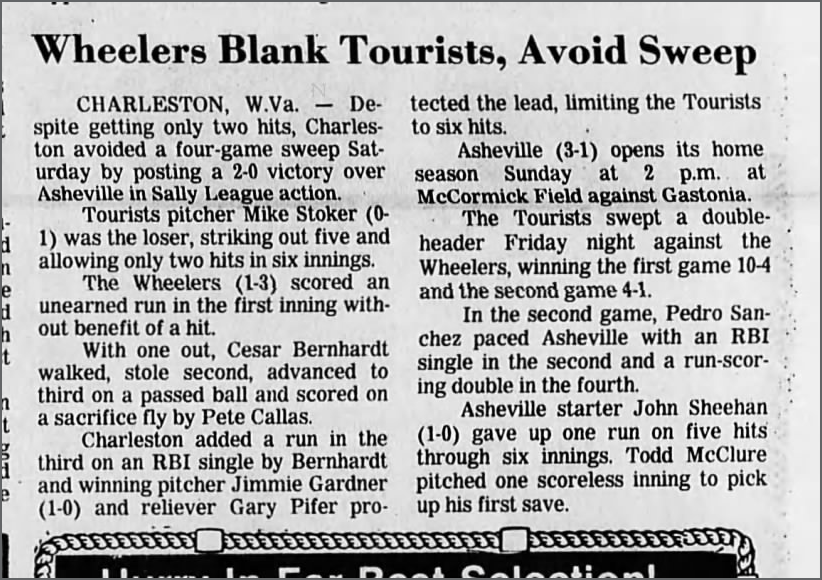
**April 12, 1987** — [Wheelers Blank Tourists, Avoid Sweep](https://www.newspapers.com/article/asheville-citizen-times-wheelers-blank-t/135569601/) — Asheville Citizen-Times
### May 1987
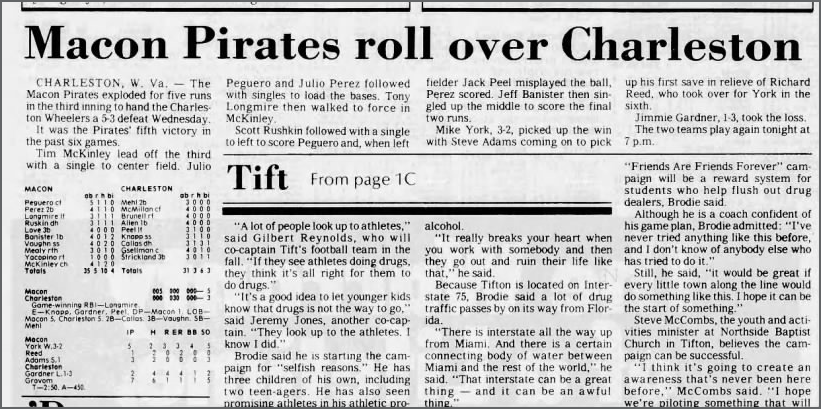
**May 14, 1987** —[Macon Pirates Roll Over Charleston](https://www.newspapers.com/article/the-macon-telegraph-macon-pirates-roll-o/135569752/) — The Macon Telegraph
**May 16, 1987** — [Day attack took place](https://archive.is/9roEz)
### June 1987
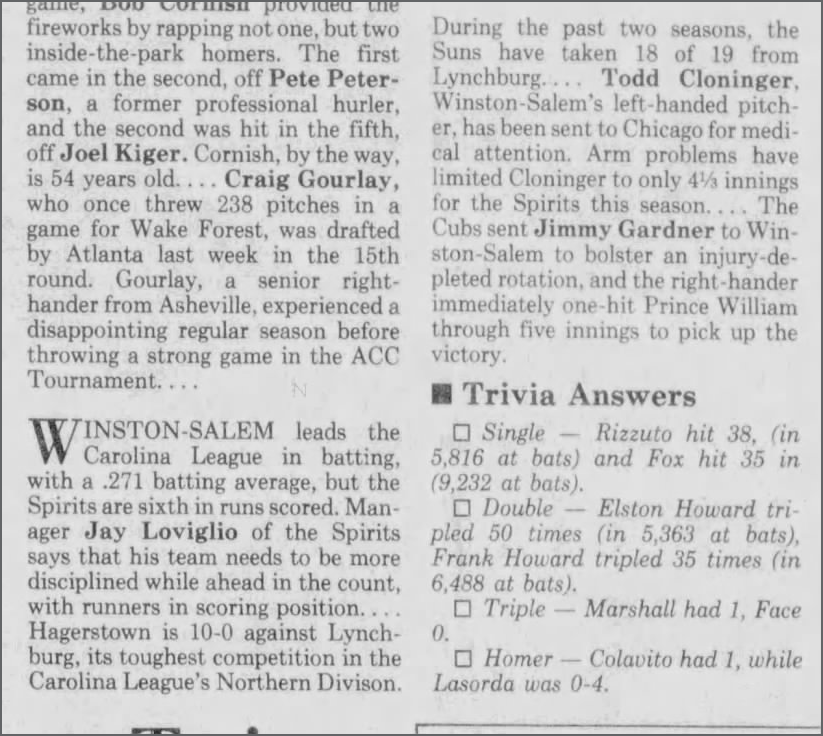
**June 8, 1987** — [Gardner to Winston-Salem](https://www.newspapers.com/article/winston-salem-journal-gardner-to-winston/135569945/) — Winston-Salem Journal
### July 1987
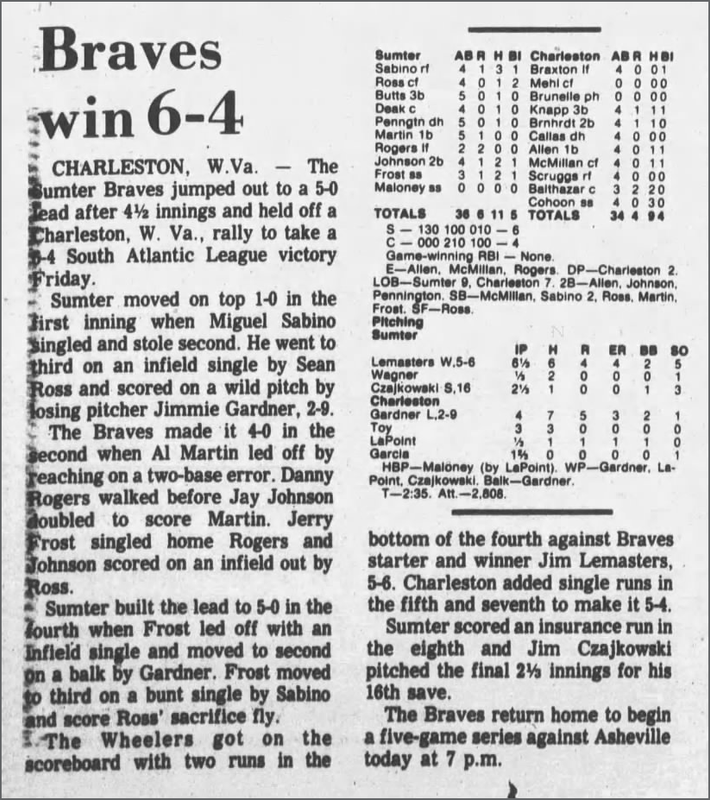
**July 25, 1987** — [Braves win 6-4](https://www.newspapers.com/article/the-item-jg-in-charleston/135505032/)
### November 1987
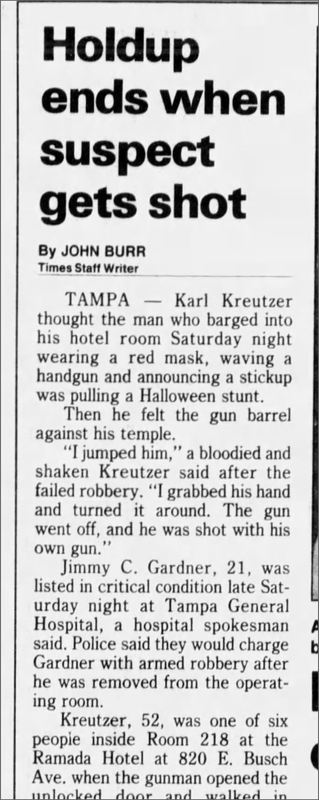
**November 1, 1987** — [Holdup ends when suspect gets shot](https://www.newspapers.com/article/tampa-bay-times-jimmie-gardner-arrested/135503465/) — Tampa Bay Times
> [!grid|masonry]
> 
> 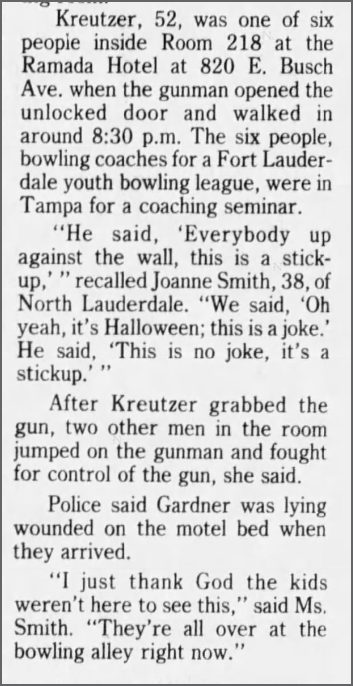
**Note:** November 1, 1987 was a Sunday. This means the robbery occurred on Saturday, October 31, 1987.
### March 1990
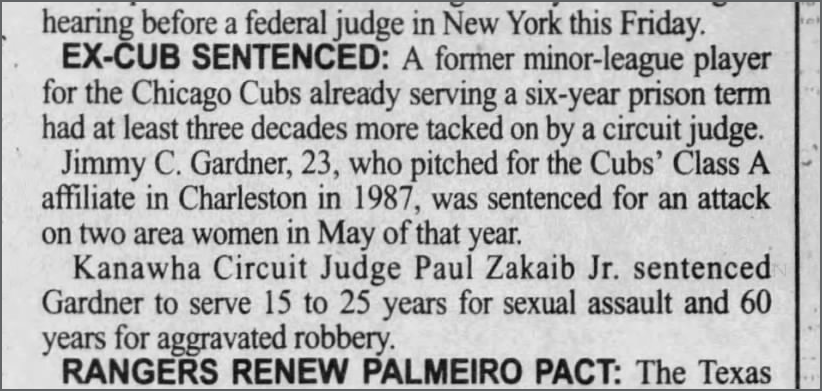
**[March 6, 1990](https://www.newspapers.com/article/the-times-jimmie-gardner-sentenced/135502722/)**
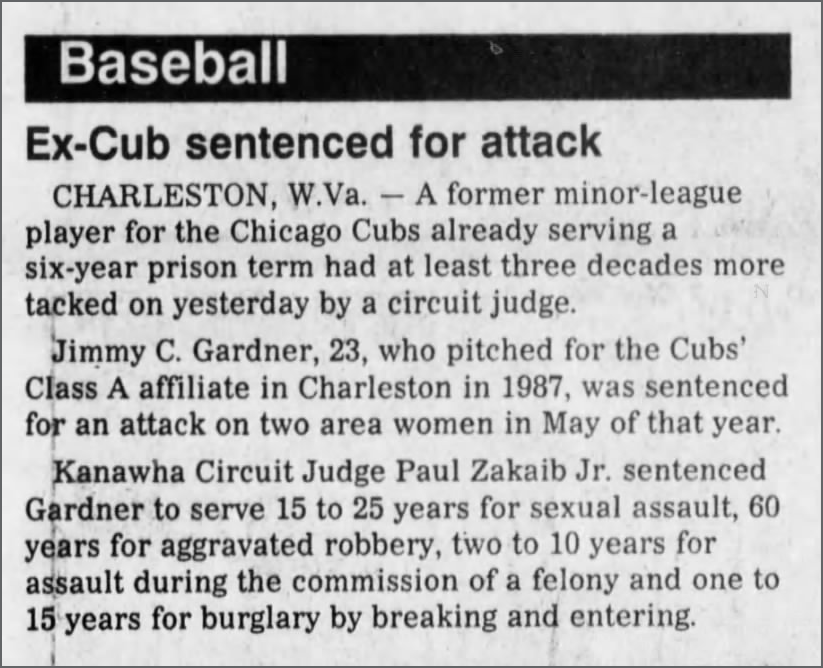
**[March 6, 1990](https://www.newspapers.com/article/the-pantagraph-jimmie-gardner-sentenced/135502868/)**
### July 1994
**July 17, 1994** — [Prisoners say tests could set them free](https://www.newspapers.com/article/lansing-state-journal-lansing-state-jour/135431316/) — Lansing State Journal

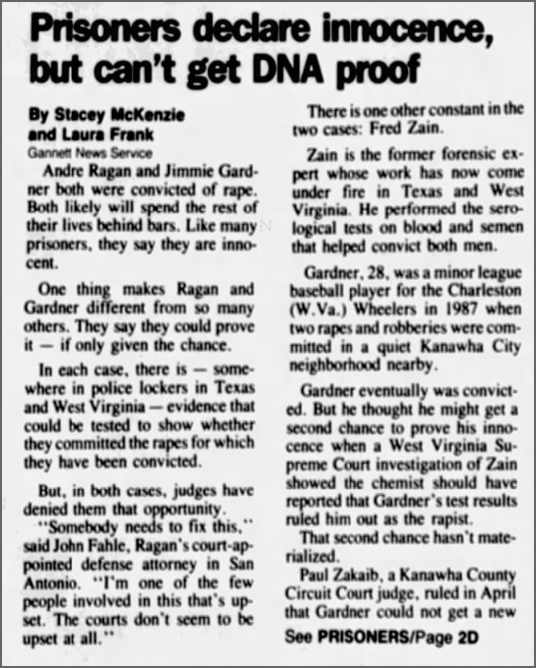
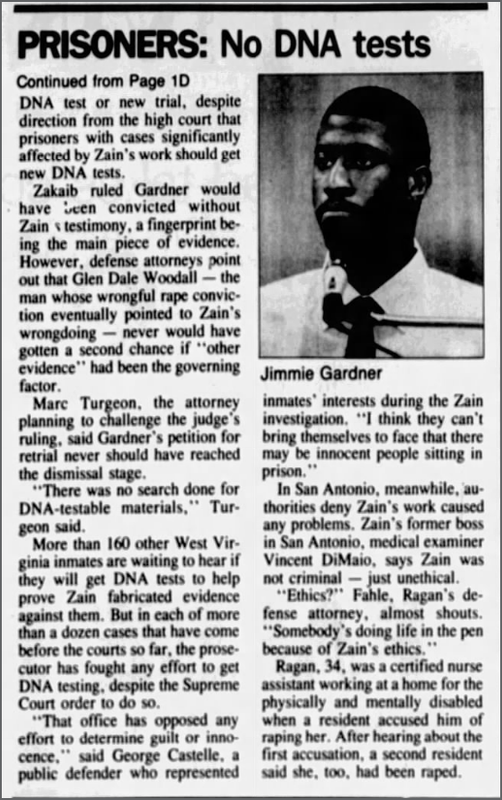
**July 18, 1994** — [Prisoners declare innocence, but can't get DNA proof](https://www.newspapers.com/article/the-californian-prisoners-declare-innoce/135568984/)
> [!grid|masonry]
> 
>
> 
### April 1995
**[April 23, 1995](https://www.newspapers.com/article/the-tyler-courier-times-dna-tests-ordere/135503095/)** — DNA Tests Ordered In Rape Conviction

### August 2014
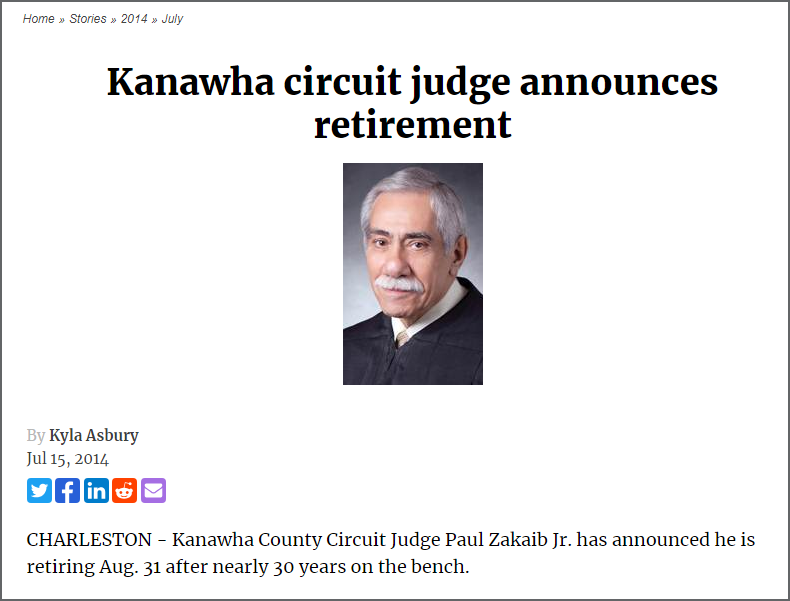
**August 31, 2014** — Paul Zakaib Jr. Retires | Kanawha circuit judge announces retirement — West Virginia Record
### October 2014
**October 7, 2014** — [W.Va. Gov. Appoints New Judge in Kanawha County](https://web.archive.org/web/20141022135644/https://www.wsaz.com/news/charlestonnews/headlines/WVa-Gov-Appoints-New-Jude-in-Kanawha-277887411.html) — WSAZ3
Joanna I. Tabit[^JT] replaces Paul Zakaib Jr.
[^JT]: [BallotPedia Profile](https://ballotpedia.org/Joanna_I._Tabit)

### March 2016
**March 25, 2016**
Charleston Gazette-Mail — [Citing Zain testimony, judge orders new trial or release for former Charleston Wheeler](https://archive.is/zOfiM)
**March 30, 2016**
WSAZ3 — [Former Gardner lawyer offers insight to case](https://archive.is/1opVT)
### November 2016
**November 22, 2016**
WCHS — [Jimmie Gardner reflects on chain of events that led to release from prison after 27 years](https://archive.is/9roEz)
> Kanawha County prosecutors opted to retry Gardner, saying that DNA evidence found inside the victim did, in fact, match Gardner and so did the fingerprint.
>
> Prosecutors told the judge that **Zakaib did order new DNA testing in 1996 and that it did not clear Gardner**.
>
> "As a matter of fact, they determined, statistically, that **there is a one in 13,500,000 percent chance that someone else would have had that DNA profile**," prosecutor Don Morris said during a hearing earlier this year, before it was announced they were not proceeding with the case.
>
> Just days before the trial was set to start, however, **prosecutors dropped the charges, saying that the memories of those who worked the case nearly 30 years ago were so faded and unreliable that they couldn't proceed**.
**05-16-1987**
> On the morning of May 16, 1987, a mother and daughter were getting ready to have coffee on their patio of their home on Virginia Avenue in Kanawha City. The elderly mother was brutally attacked, and the daughter was raped. Cash and a cassette player were stolen from the home.
>
> Two months later, another woman was sexually assaulted in her home in Kanawha City.
>
> Both women said their attacker was black, and Charleston police started zeroing in on Wheelers players who played at nearby Watt Powell Park. There were more than 100 suspects.
>
> Years went by with no arrests, until a bloody fingerprint left at the first scene came back as a match on Gardner after he was arrested for a crime in Florida.
>
> Source: <https://archive.is/9roEz>
### March 2018
**March 12, 2018** — Jason Flom with Jimmie Gardner
Archive: <https://archive.is/2VG7u>
> [!abstract]- Podcast Description
> Jimmie C. Gardner was a Charleston minor league baseball player when he was accused of sexual assault in 1987. He grew up in Tampa, FL and was drafted by the Chicago Cubs just after high school graduation, playing with them in the minor leagues for four seasons. In 1990, while working towards his business degree, Jimmie Gardner was arrested and charged with robbing and raping a woman and physically assaulting her and her mother at a home in Kanawha City. Despite always maintaining his innocence, Jimmie was put on trial and prosecutors used West Virginia State Trooper and Chief Serologist Fred Zain as the expert witness. Zain knowingly presented false testimony which resulted in Jimmie's guilty verdict, and he was convicted of two separate counts of robbery and sexual assault as well as burglary and assault-during-the-commission-of-a-felony and sentenced to 110 years in prison. Jimmie Gardner's case is one of over 140 cases from the late 1970's through the 1980's in which the state of West Virginia relied on falsified forensic evidence testimony by Chief Serologist Fred Zain in order to convict. It was not until April 1st, 2016, nearly 3 decades after the Chief Serologist was exposed—when Jimmie C. Gardner's case was overturned, and he was finally released after serving 26 years in prison. Since his release, Jimmie has become an active motivational speaker and is in the process of establishing the Gardner House, a 48-bed facility dedicated to providing shelter, food and opportunities to people recently released from prison. For more information on how to book Mr. Gardner, visit [www.jcgardnerspeaks.com](http://www.jcgardnerspeaks.com/). In this episode, he is joined by his attorney A. Scott Bolden, Managing Partner of Reed Smith, Washington, DC and the Honorable Leslie J. Abrams, United States District Court Judge for the Middle District of Georgia.
<iframe src="https://omny.fm/shows/wrongful-conviction-1/048-jason-flom-with-jimmie-gardner/embed?style=Cover" width="100%" height="180" allow="autoplay; clipboard-write" frameborder="0" title="#048 Jason Flom with Jimmie Gardner"></iframe>
> [!abstract]- Click to View Transcript Highlights
> - Jason Scott Bolden, his attorney is here. Scott, welcome to wrongful conviction.
> - I am originally born in Dawson, Georgia. We left when I was I say to my mother, says three years old, So I'll go with three. We left and went to Tampa, Florida. And in Tampa Florida, that's where I was raised at I went through the Tampa Florida School System, Hillsboro County School System.
> - I got drafted out of Tampa Bay Vocational Technical High School in nineteen eighty-four by the Chicago Cubs.
> - When I first arrived into Charleston, West Virginia, I can still recall all the guys in in the jail, old seals telling me. They called me Florida. They said, Florida. You can't win here. You just don't go to trial and win here. And I'm telling the guys I'm not guilty of these crimes. Man. They said, man, but you can't win. You don't win in Charleston, West Virginia.
> - And at this time I'm knowing that I did not do these crimes, and I don't have that worry that you guys are talking about. You guys are talking about. You know. I had the prosecution offer ten years to me, and my lawyer said, uh. He said, Mr Gardner, this is the best deal that you will ever get. These are ten years for these type of charges. He said, you go to trial, you'll get ten times this. He said, you'll get beyond that. He said, this is the best deal. He tried everything to get me to take a deal. I said, I didn't do the crimes. I'm not guilty of these crimes. I'm not pleading guilty to anything.
> - And those ten years turned into a hundred and ten years once I was convicted. And going through that process until I was actually convicted, and I heard the jury say guilty, I did not think then I would be found guilty. That's what made it such a shock going back, because as I say that, the attorneys telling me, the longer they stay out, this is excellent for us. You know, this is excellent. They can't come to an agreement, and the judge Stelly sends them back. You gotta go back. They said, Judge, we were dead, like we were at the position, we don't we can't move forward. You got to go back. How long was the trial? Probably a week and in the end I was actually convicted and sentenced to one and ten years, which was a shocker, to say the least.
> - To go from that and to come to where you are now, how did you manage to bounce back? How did you How did you manage to persevere? How did you manage to fight? I mean, it's it's a process, and that's not a process that's that's done overnight. At that point after I was convicted, I mean I was in shock, but I knew in my mind I was in for a fight. I knew that there's no time for crying and laying down. That's just the individual that I am and my upbringing. You know, it's not time to really cry and sulk. I know it's time to fight for my life. And I guess I had been bred for this adversity. Adversity is something that I've had to overcome and basically outlast my entire life. And this, this guilty verdict, this guilty verdict, was a slam to me, but I just know it changed my entire life. The young lady that I was dating at the time. I had to let her know that our relationship was over and let her know that I'm in Charleston, West Virginia with my life basically just taken from me, and I have got to fight. So I ended a relationship in nineteen eight or ninety that began three and that was a difficult decision, but I just ended that because I knew now I'm in Charleston, West Virginia, a young man from Tampa, Florida. I'm used to being in a totally different environment, and now I'm in Charleston, West Virginia. White in West Virginia and two percent black at that time, which was that was major to me. But I have to put in my mind this is live or die.
> - Well, when I first went into the West Virginia prison system, I went to the West Virginia Penitentiary in Moundsville, West Virginia. And this penitentiary was actually declared unlivable at the time. I guess they were in the process of closing the prison down, unlivable. That's an interesting work because it was it had been deemed just horrible, the conditions and everything.
> - And I still remember the day I arrived at the prison and all I could do was just kind of stand back on the wall and look at the different faces of individuals. I mean, I'm in I'm from Tampa, Florida, I'm in an environment I know no one, And you have skinheads, Aryan brotherhoods, motorcycle gangs, Klu Klux Klan. You got a number of gangs, within this prison. And it may have been out of fifteen hundred prisons. It may have been a hundred black guys, may not. I do only think it was a hundred black guys. It was a different world. It was a very different world.
> - The majority of the black guys were I'm gonna say a little subservient to a degree because they didn't want any trouble. You know, it was certain hits being sent out on on individuals.
> - And it was just a completely different world for me at that time. And my first objective was I gotta get to the law library. I gotta learn this law.
> - Unfortunately, I was encountered by an individual that ultimately led to me going to lock up for a little bit. So I stand a few years in lock up over the incident. I don't choose to speak about to day, but it was a fight that turned into a little bit more. And this thing, you know, I'm gonna lock up for a period of years. And what is that lock up is punitive segregation and on punitive segregation in Moundsville, West Bertweinia Penitentiary. It's worse than the mainline population, it was pretty rough. You had officers that had shotguns. There's a couple of shotguns on every section.
> - It seemed like shotgun here, shotgun over here, shotgun, shotgun, shotgun, and you're on the inside and it's just all this steel, these little cages. I can touch all four walls by just reaching out and touching the walls from north to south, east to west. And the sale was that little with the little sink toilet in the bed, and I stayed over there for a period of time, and that gave me an opportunity to really hone in on who I was and who I am.
> - I started reading, I started studying. I made my way to the law library versus going out to work out. And you have an option. You can work out or you can go to the law library. So my law library time started about two or three in the morning, so I would go to the law library. And it's ironic, one of the Arian Brotherhood guys, he taught me how to shepherd eyes, taught me how to go in and read all different cases and familiarize myself with the legal process. He really helped me gain a foundation in law. On lock up that's that for a Second's that was?
> - That was my first encounter. And I always tell people, you know, I'm indebted to this guy, an Arian brotherhood guy teaching one of the few black guys and the maximum security prisoner in West Virginia about the law is something worth spending a moment on. I mean, this is remember this guy's name, sure, sure, Joker, Marcus Cockerham. We became the best of friends from not knowing anything. So he taking the time out to go over with me in this law library about similar cases, reading up on on on this, understanding the different rits and filings, and you know, I mean it was. It was priceless.
> - And I can still hear him saying, you will not do a lot of time on this because this is crazy. Your case will be one of the biggest cases in the state of West Virginia. And all he used to talk about was men, they're gonna pay you so much money. That was what he was saying. And we actually we studied so much and we we really be came good friends. Behind that he's still in.
> - So you were moved around to a few different presents. Let me see from from Moundsville Western Penitentiary we left there in nineteen nine, they closed the prison down.
> - So I left Moundsville Western Penitentiary in March of 1995 and I went to Mount Olive Correctional Complex in Mount Olive West Virginia. I stayed at Mount Olive Correctional Complex for a period of I don't know, maybe I don't know seventeen sixteen, seventeen years, because I left Mount Olive in two thousand and eleven and I went to Huttonsville Correctional Center.
> - I left Huttonsville and went to Northern Correctional Facility. Then I went to the Northern Correctional Center. Then I came back to Mount Olive Correctional Complex before I was released, and that was in 2016.
> - I mean, you really had a tour of the worst places. And I'm sure than anyone can imagine. Let's take the twenty seven years you were incarcerated. What was the worst thing that you saw that happened and all that time. I mean there it's a lot of worse. The worst happened at Moundsville. That was the worst. I go back to the winter of 1993 in Moundsville on lock up. I've never been that cold in my life. All the windows in the lock up are knocked out. And this was prior to an incident that happened in six. It was a riot there in night six and the windows never replaced.
> - Yes, so all of these windows are knocked out, and I'm I'm on the fourth tier, I believe on lock up, and the snow is just blowing in and it's just cold. I got all the clothes I got, I got all my clothes on. I'm so cold that I don't get up out of bed to eat for a few days. I remember writing in my journal, this is the first time I ate oatmeal. I was so hungry. But you know, I got up after like day two or three and eight oatmeal that was it.
> - But it was so cold that the toilet was literally ice. In order for me to use the facility, to use the restroom, I had to break the ice ==with my shank==. I used my knife, my shank to break the ice in order to use the toilet. I had never been that cold in my life. And I and I pitched in I pitched in Wisconsin, Appleton, Wisconsin, right off of Lake Michigan. And I remember being cold off of that Lake Michigan.
> - And I and I thought that was the coldest, but until I went to Moundsville, West Virginia that winter it was so cold. I kept myself one on by talking and yelling. Just it was torture and you gotta try to. You gotta try to, I guess, yell and keep moving, get to stay warm. Yeah, that was pretty rough. That was That was the roughest time.
> - And then on top of that, I mean there's stabbing is over there every every day, if not every other Day's so many gangs, there's so many hits being sent out in this in this little area, and you've got stabbings going on. You have the officers using the pump shotguns. I'm still hearing the click boom, that's that's that's the sound shooting guys. They'll make that warning, they say they make a warning shot, but they'll actually shoot the buckshots into the area. I still remember the guy saying, the next one will get you. I won't miss with the next one. The ring from that shotgun going off, and I'm crawling on the ground, just crawling to try to get away from this, this this situation, because you're not expecting nothing like that to happen.
> - Shooting going on with then lock up I mean, but the stabbings are happening so so frequent, and the officers are shooting to to stop the stab mans. I mean, not justifying it, but it was just mad Lands to me. I'm like, I'm in a crazy, crazy spot. So I had to take my whole psyche to another level. I am in survival mode. I'm gonna make it out of here. I still remember that I'm gonna make it out of here. I'm saying myself, I'm writing this down, I'm gonna make it out of here. I'm not going to succumb to this. And you know, I had that in my my writing and my journal, but I kept myself active, you know, and that's when I would go to the library and I come back, you know, even while I'm studying the law and and getting all the information I can, I started reading a lot of different books.
> - I'm reading up on Catholicism, Buddhism, Rostafarnism, Islam, Christianity, the Box Da Vita. I'm reading everything I can read and understanding different faiths. And I'm also at this time doing all my other readings. You know, I always mentioned Dr Victor Frankl's book Man Search for Meaning and I always mentioned James James Allen as a man thinking I'm just reading so much and I'm taking time out of my day to read this. Reading was like this is getting me through the day.
> - You're free==zing, you're starving, and you're trying to avoid being stabbed and shot. Everything else going okay, I mean, I'll say this. I mean it was a very it was very It was very racist in this in this prison. So you never know when a hit may come your way, when when someone may come you and you don't have to even be the subject of intent. You don't have to be that peron. You don't even know the person.==
> - I'll never forget the one guy next to me, he wouldn't come out of the cell. You know, it's guys that wouldn't come out and wouldn't go to shower and wouldn't come out of that cell. And it's okay with the officers you used to stay in the cell, but it's guys that would not come out and I and I would go to him. I was like, hey, come on out to sale, come to the shower. You have a shower today, You have a showered in a week. Come on out of there, and you know it. Guys would literally say, I'm not coming out there to be killed.
> - Judge, let me ask you, because I think there's something in the Constitution about cruel and unusual punishment, how does this go on that the scenario that Jimmy is describing, it must be what the founding fathers had in mind when they wrote that.
> - Unfortunately, this is a reality of the country we live in now. Legally, there would be a great uproar if we found or somebody made a big deal about how some of our elderly are being treated and assisted living homes. But I guarantee you it would be a different situation where the law would react very differently for someone on the outside than they do when we're dealing with prisoners who sometimes we forget are still citizens. They are still Americans, They're still entitled to all of their constitutional rights. And so, to answer the question, not passionately, but legally, there is a mechanism to address at But is it adequate? I would say no,
> - The scenario that Jimmy is describing in most states, I think if you treated your dog that way, go to jail, you go to jail. You can't you can't leave your dog in a tiny enclosure in freezing temperature, sub freezing temperatures. It's unconscionable. And I mean, I will say because of what I do have to believe, and I do believe that there is a possibility of justice. So this person that Jimmy was in was because of a legal case condemned. Now it was condemned six years before they closed it, but really there was a case saying you cannot house people in these conditions. What happens with the administration after that decision comes down is something entirely different. So I would certainly agree the laws to protect our animals are oftentime more stringent and more closely followed than we do to protect our brothers and sisters. And that is a very big problem in this country.
> - It's so nuts. Right one day, you're just a person walking around the street with your rights, but as soon as that switch goes off, you're caught up in the criminal justice system. You're you're not treated as a human being anymore. And that's got to change.
> - And when we look at it, even in the most self serving way, for the most part, people are going to get out of prison at some point. They're going to be in our neighborhoods. They're going to be in the supermarkets, they're going to be back in society, and if we have treated them as subhuman for however long they're there, we are going to read the consequences of how they're going to react when they come out. One of the things I admire most about Jimmy is that he'll say that even though he was in jail, his mind was never there.
> - Well, he's he's an unusual he is an unusual person. But we really do have to step back and look at how we're treating people. Even if you don't care, even if you did something bad and I don't care about you, be selfish and understand that for the most part, they're going to come back out and then you're going to have to deal with it. That's why we're doing reentry work with people needing jobs, needing housing, all of these things. We have to keep in mind that we are all part of the same society and we've all got live in it.
> - We need to do better. We need to we need to do better. We need to treat our people as people. So, Jimmy, how did it transpire? How did you rebound? How did you get out. What was that moment like when you got out?
> - Um, I mean this. I was overjoyed. I was released through the federal courts. I spent forty six months in federal court on top of a twenty three year in order and delay in state court. And my mother, Miss Gladys Gardner. You know, my mom is a very very praying woman, and she she has visions. I was waiting up to six maybe five months at the time, and my mom said, well, I went in the closet and you're coming home. You be getting ready to get your rule, and you're coming home this week. She said, so go ahead and pack up everything. And I said, okay, Mom. I was talking to her that Sunday and I got I got the call on Friday from my attorney telling me that the case had been overturned, conviction vacated, and either set for retrial or release. And I called and let my mother know that. That Friday, I said, Mama, I got the ruling, but she already saw it. She saw a vision, Like I said. My mother is very very praying, very very prayering, spiritual, and I have been preparing for April one. Seems like all my life, every year that would go by. I pray. I said, God, please let me come home this year. It's January one, and I watched that ball drop right here in New York. I watched that ball drop, and I said, God, let this be my year. One day, I'm gonna go and watch that ball drop. And I I said that, and I believe that wholeheartedly. Every year, I would say, God, let this be the year. That's a few that case went by, but I watched that ball dropping. I watched that every year. Let this be my year. And I go through my years in prison, letting guys know I'm going home this year.
> - Well let's go back to that, though, because you actually bumped into a very principled judge who made a very strong ruling and an even stronger statement when he announced that your conviction was being all returned. And you must have very special feelings for that man. I don't know him, but I'd like to meet him. Sometimes shot his hand. So can you talk about that?
> - ==Oh? Yes, I can, with great pleasure. You're speaking about the District Court Judge Joseph R. Goodwin, Southern District of West Virginia.== I fouled my case into his court in June of two thousand twelve and November of two thousand thirteen, Judge Joseph are Goodwin granted my my petition and enabled me to come into federal court, which was a miracle because I had no standing, no legal standing, and I also filed under the denial of access to the court, denial of equal protection and due process, which aren't you know, issues that aren't cognizable in federal court. You know, it has to be an issue dealing with constitution violation that emanated from your trial. So I mean, I'm going in already knowing this, and I tell you I placed one of my petitions into my filing because I was asked to do that by a guy by the name of corneill Day. So he said, man, you've got so many petitions you filed in court, man, just go ahead and throw one in. Let them know you have something. So I did that, but Judge Goodwin denied my petition, but he granted me into federal court because of my exhibit of one of my state court petitions. And at the end of the day, Judge Goodwin rule that I had shown that I had issues that may want some relief in federal court. So he's gonna give me that opportunity to present my petition to the court and get my case hurt for the first time, get my case reviewed for the first time. And this is the first time review I went in federal court under a d novo review, my first time getting a review in twenty four years, which was remarkable. But Judge Goodwin stated in his in his opinion that I had been in legal purgatory and that it had been a total miscarriage of justice, which were some very strong words, very strong words. And I just ==know that in order for Judge Goodwin to have the courage to do that in the state of West Virginia, that took so much courage, That took so much I mean, I can't even express it to the audience.== And within Judge Goodwin's opinion, I mean, he's right across the hall in the same city as the state judge that sends me to a hundred and ten years and they're good friends.
> - And let me just read something because Judge Holiday said that Zanes and I'm quoting pattern and practice of misconduct completely undermined the validity and reliability of any forensic work he performed or reported and that as a matter of law, any testimonial or documentary evidence offered by Zane at any time in any criminal prosecution should be deemed invalid, unreliable, and inadmissible in determining whether to award a new trial in any subsequent habeas corpus preceding bam right. So I can ask the judge, it sounds to me like the judge was pissed.
> - That was from the Supreme Court of West Virginia, and yes, he was very upset, and that should have formed the basis for an immediate rehearing, if not released. That decision, I believe came out in November 1993, so that that ruling came out out saying that every person who had been prosecuted by or convicted but because of testimony from Zane should get a rehearing. Jimmy, I think was granted four more than that.
> - One of the real injustices here isn't just Zane's deplorable and illegal behavior, is that once that Supreme Court did its investigation and ordered a new trial for not just Jimmy, but anyone who had been convicted based on Zane's evidence, they either weren't going to be released or they would have to be retried, and the local prosecutors and these jurisdictions had to determine which one it was going to be. The local prosecutors in Jimmy's case decided that they were going to retry him rightfully or wrongfully. But then the trial judge in this case, when he would file his petitions, and you say filed four, I think he filed more than that. But there was several state habeas corps his petitions file pursuing to the Supreme Court decision, the state Supreme Court decision, and this particular judge refused to give him a hearing. So he languished for ten to fifteen years, twenty years, I'm sorry forgive me twenty years in a state of legal purgatory, essentially because he could not go to the federal system until his state case or state habeas case had been tried or heard. And for twenty years they didn't hear it or try it, and so he languished. He finally filed something in federal court out of desperation, and this judge, is federal judge, took it up despite the standing issues because how abhorrent the state system had treated him. He had never had a hearing. So we talked about those who were who contributed mightily to his twenty seven year incarceration. It just wasn't the state police and and and Zane. It was also the Judd Shary at the state level that worked purposely to ensure that he would be in legal purgatory for twenty years. So twenty of the twenty seven years, even after Zane was found out, it was the system and the state court system that kept him there. And so when you talk about making him whole, it's not about Zane, just about Zane in the state Police department, it's the state judiciary system and the prosecutors who knew he was in prison, knew he was suffering, knew they were in the court or to give him a hearing, and knew that they weren't given him that. It really is abhorrent. And so the fact that the matter is but for this federal district court judge who found a way legally to rule right and to to direct them to give him a new hearing or to let him go. Because now we're in with a federal court judge who's got a lifetime appointment and says let him go. ==By some date certain or retrying. Even after all of that, the same state prosecutors, the same state police offered or decided to retry him again, and on the eve of trial, on the day of trial, approached the bench and decided they weren't going to retry him allegedly because of lost witnesses or lost memory of witnesses. That wasn't the case. They couldn't prove the case twenty seven years ago. They couldn't prove it twenty seven years later.== The bottom line proposition because anything that Zane had touched and anything that State lab and those working with Zane had touched was not credible. And the whether you had the witnesses or not, it was the tainted evidence that ultimately convicted him. And that's the second tragedy of his incarceration.
> - It is absolutely fucking nuts that Zane was exposed and actually indicted in 1993 but he had gone to Texas right, had gotten fired from the position in Texas, and when he came back, the state police and had welcomed him back despite all the findings against him. He worked as a consultant to them and convicted other people on bad evidence when he returned, very powerful bad evidence too. I mean, because again, hard to argue with the guys up there, but talking science that people may or may not even understand, people can't challenge it.
> - Often wondered with Jimmy and and even the prosecution on the other side, now that I'm involved in the case post his release, as who could find the motivation to wrongfully convict hundreds of innocent people based on bad analysis, poor analysis, or just perjured testimony on a repetitive basis a practice, a part in practice of wrongfully convicting people. What motivates a human being in law enforcement? Who most of them swear to the Constitution into the flag and where the flag on their sleeves, on their shoulders, right to wrongfully convict and criminally through criminal cond convict innocent people? Where does that come from? What manner of man is that?
> - Yeah? And of course we know that in every one of these cases in which Zane and others like him have deliberately, willfully, wrongfully testified against people like Jimmy or they knew were innocent, And every one of those cases, the actual perpetrator remain free to go and and and go and commit other another bucket, it's a whole another bucket, but it's an inescapable truth. But you know, I want to talk about the good stuff. When you actually were let free, did you walk out of the courtroom like in the movies into the sunlight? Is that what happened?
> - It was on April one, after hearing, and this hearing is to decide whether not I'm gonna be retried or released. And Judge ==Joanna Tabot,== I'm in her courtroom, and like my attorney, Scott Bolden said, the state decided they were going to retry. So Judge Joanna Tabot set a bond in my case. And she asked my mother, Ms. Gardener, can you please stand? And my mother stood up and my mother told her yes, ma'am. She said, can you tell me what kind of bond can you make? And my mom said, I think I can make ten thousand dollars.
> - And Judge Tabot, you know, which is one of the greatest judges in in West Virginia right now, her and Judge Joseph Arra Goodman, federal judge, she said, with a bond had said at ten thousand. She said, Mr Gardner, take him home with you. Take him home. And my mother, my sister's Barbara Gardner, Harrison, Tracy Sims or my brother Eric Gardner, my other brothers, my my friend Sheila Louis, so many other people, my my my nephews and you know, my nieces. It's so many people waiting on me to walk out of that that jail. I walked out of that jail on April one to the arms of my family, and that that moment was so exhilarating, you know, all of us. We just met with a big group hug and I embraced everyone and we shared a lot of tears of joy.
> - Of course, the the news reporters, like you know, they're they're seeking to retry Mr Gardner's In my mind, I already knew this was over, this was over. And my mother said they can do whatever they want to try this and that she said this is over. She said, my God told me this is over. And I knew it was over. So I embraced my family. We hugged. Man, we went we went out to eat, ==we went to the hotel and party, and I mean we parted.== Man. You can't put you can't define it, words can't explain it. I couldn't even imagine so being wild a crazy thing happened just a couple of months ago, because you've been out now for about twenty two months.
> - What was the date of the formal exon September seven, So there was another mile stone right like you knew it was coming, but it still had to be a great feeling. And you were telling me earlier about a crazy story in the best possible way you want to talk about that, Okay, Um, I'll just say this.
> - You know, since I've came home, I've had the opportunity to speak. I do my own speaking now. I'm J. C. Gardener Speaks. I have a Gardener House incorporated in Beckley, West Virginia. That house is a house for returning citizens, giving man opportunities to have housing, clothing, food. This is going to get off the ground pretty soon in the process of renovating it now. And I've been speaking and been fortunate to meet so many people and attend so many different universities, Congressional Black call becauses. I mean, it's just been phenomenal, phenomenal to say the least, the opportunities that I've had.
> - But last year I happened to meet Judge Leslie Abrams in all Benny, Georgia, We were at a Georgia Black Women Lawyers associating a party or something like that, and I just happened to meet Leslie and we talked, I don't know, maybe hours, maybe hours, so so it was extended time. And it was at that time that I realized it was it was something that that was really gravitating me towards her, and you know, I felt like I had found what I was looking for. And today Leslie and I are a couple. I mean, my blessings have been It's like a river flooring.
> - You found love in the form of the judge who happens to be sitting right next to me right now. What a like an amazing circle now right, I mean talk about the criminal justice system giving back. I mean, you know, it's like for somebody who has been as wrong as you can be, it's an amazing it's an amazing, amazing and wonderful, beautiful part of the story. And uh, you're a lucky man, So the luckiest of the unluckiest people that I know.
> - I'll say. I'll say this, Jason, I've been blessed beyond imagination. I can't even describe it. I've meant nothing but great people since I've been home. It's almost like everything you encounter it's gold. Everything that I have encountered since my time of being home has been good for me. I'm in a situation where I know I've been blessed beyond imagination, beyond the normal human being can be blessed their entire lives. I'm fortunate to have a great attorney such as Scott Bolden sitting next to me. I'm fortunate to have a great lady in my life, the Honorable Judge Leslie Abrahams Blessed. My mother and father are still here, My sisters and brothers are still on this earth with me. I'm in the presence of my my nieces and nephews and my family members all the time. I am blessed beyond comparison. And I'm blessed with health. To come out of mound's Ville, West Virginia Penitentiary and go into Mount All the Correctional Complex.
> - To come out of this situation now for twenty seven years and be healthy mentally, physically, and spiritually is beyond the blessing the miracle. Now I am in the process of taking some of getting some psychiatric help as far as because you can't go in water and not expect to get wet, So I do have to take some classes getting myself reacclimated back, get some psychiatric help in that regard, just going through the process sharing my bad times proceed with individuals with a psychiatrist being in a position to to say, hey, I'm not at any level trying to say I'm totally unblemished or unharmed by this process, because you can't.
> - You can't jump in water and not get wet. So I recognize that I'm blessed beyond the majority, but in the position that I am today, my position is to be able to tell my story to people and let them know, Hey, it's not how you start, it's how you finish, and it's not what you go through in life, is how you deal with what you go through in life, because we all go through something. Everybody got a story, and I tell people that your story is just important as important as my story. But it's how you deal with it and how you understand that you can only get through it by really tapping into your higher power and understanding that it's beyond you not tell people every day just why they say, why did this happen? To you. It's not even about me. ==It's not even about me, it's beyond me. It's a level of me being placed on this earth, not to play baseball, basketball, football into that, but to be an activists, an individual that's against in justice.== To share my story with people, hoping me that I can give them the inspiration and motivation to know that whatever going through in life, you can come out of it and you can be you can be in the best position of your life if you truly believe in your higher power.
> - And I stressed that to tell people, Look, if you can go through it, whatever you're going through, God will not place the burden upon you greater than you can handle. So no going in. If you're going through it, you can handle it. It's purposeful, you know.
> - Usually on the show I open up the mic to the featured guests for closing thoughts. I feel like you actually just out of my mouth. Yeah, and that was amazing.
> - And then lastly, I do also like to have our other featured guests share any last thoughts, anything that you want to get off your chest, or anything you want to tell the audience. Judge
> - Well, I would say that one of my passions when I was a federal prosecutor, I was in a USA in the U. S. Attorney's Office in Atlanta. I was hired by Sally Yates, and Sally Yates always talked about doing justice, but she talked about it as a three legged stool, and one of those legs it was enforcement, prosecution, but it was also prevention and re entry. She was very adamant about that night. I hope that if anything comes out of this. One of the things that when I met Jimmy, he said we talked for a very long time, and part of that was talking about one how someone could go through that experience and come out with the spirit that he has come out with, but also what he was doing. We talked about Gardner House, about how he was trying to help other people re enter into society.
> - I was the community outreach coordinator for the US Attorney's Office a period during my time there, and I did reentry work. I continue to do reentry work as a judge because I think it's very, very important for us to give returning citizens an opportunity. Not everybody has a family that's going to be standing outside when they come home. Not everybody is going to have a home to go to, food to eat, even understand the resources. Jimmy is extremely educated, but the majority of people that I see in my court have not graduated from high school, would not be able to navigate the system as he did. Because it hasn't been said. But understand the petition that got him out. He wrote, he had thirteen lawyers over the years.
> - The only one to file that federal writ was him, and he did it himself. Not everybody has that opportunity. And so, if anything, what I would say, and is the most important thing that I think can come out, is that people understand that these are our brothers and sisters. When they went into prison, whether rightfully or wrongfully, convicted and there are brothers and sisters when they come out. One of the reasons, and Jimmy and I talked about fate. I'm the daughter of to United Methodist ministers.
> - My father ran post prison ministries when I was a child's wife, spent a good deal of time in jail. I spent several birthdays in jail. And one thing I was always taught is not your circumstances, it's how you deal with those circumstances. And one of the things that really has drawn me to Jimmy is I have been inordinately blessed in my life. I can't imagine confronting what he's confronted and doing it with the grace that he has done it with amen to that,
> - And so I just say, if anyone is listening, please reach out, look at what opportunities for re-entry are there in your communities, and try to get involved, because we are all part of the society and we've got to gure out how to make us all one.
> - As Leslie said, I went through thirteen attorneys throughout a twenty about a twenty three year period. I went through thirteen attorneys that never foul habeas corpus or on my behalf, and I strongly suggested people to have legal representation before you encounter any type of situation that that that is similar to mine or just like mine. We have life insurance, we've got home insurance, car insurance, and these insurance, these insurances are something that we're paying for prior to us getting involved in an accident, or prior to us dying, or prior to us having something happened to our home or something. So I am a legal Shield Associate. You can pay a fee that will cover you and if you're getting involved in any type of accidents, be covered. Have an attorney already on on standby, and have access to your attorney. Seven questions Seven, I'm covered. I want you to be a covered and it's Legal Shield Associate dot com slash Jimmy C. Gardner and you can actually reach me and go on and sign up right now and be covered.
### November 2019
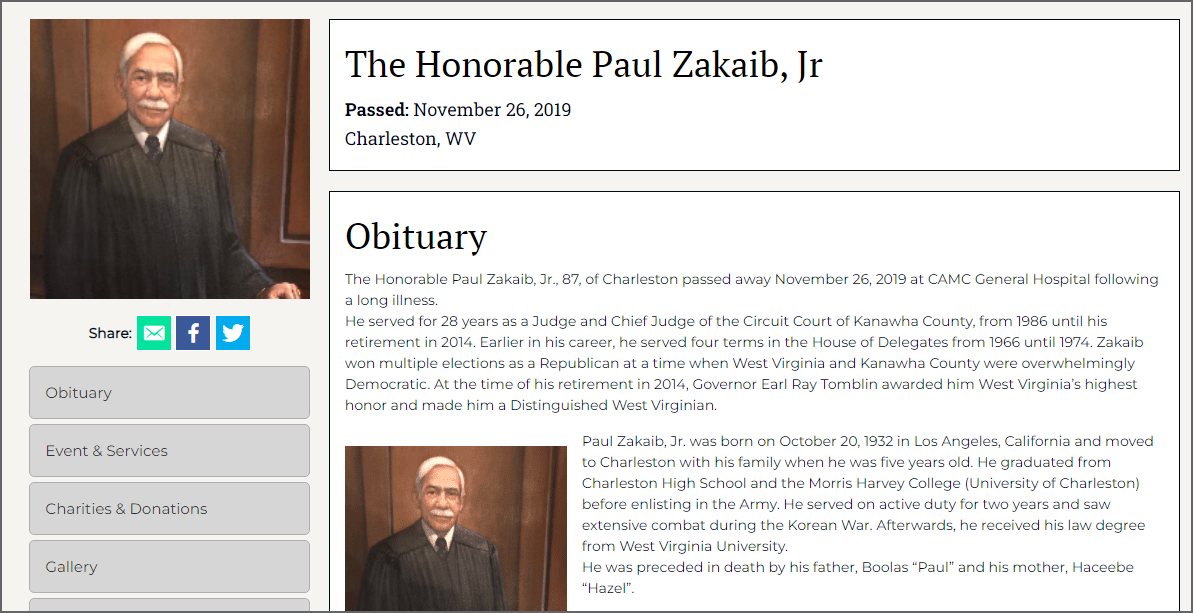
**November 26, 2019** — [The Honorable Paul Zakaib, Jr Obituary](https://archive.is/WXrdW) — Barlow Bonsall
### September 2020
**September 30, 2020** — [[Chapman University — Criminal Rights Advocate Starts a New Chapter at Chapman]]