**Previous Episode: [[BDE409 ]]**
**Next Episode: [[BDE411 ]]**
%%Post image thumbnail below.%%
> [!abstract|no-i] **Episode Overview**
**Date Aired:** [[02-13-2025]]
**Title:** Brinksmanship & Gunboat Diplomacy
**Episode:** 410
**Description:** Brinksmanship is the practice of pushing a dangerous situation or confrontation to the limits of safety in order to force an advantageous outcome.
**Link:** https://rumble.com/v6kkmbm-big-dig-energy-410-brinksmanship-and-gunboat-diplomacy.html
**Tags:**
%%<https://historydraft.com/happened/what-happened/1-January/world>%%
## Replay
%% Get embed URL then highlight and hit ALT + I%%
<iframe src="https://rumble.com/embed/v6icpn7/?pub=6eeyh" allow="fullscreen" allowfullscreen="" style="height:100%;width:100%; aspect-ratio: 16 / 9; "></iframe>
<br>
## Greetings & Announcements
1. Sorry for being a lunatic, but you should expect it by now.
---

## Segments
### Eras of Presidential Foreign Policy
#### Monroe Doctrine
Date: December 2, 1823
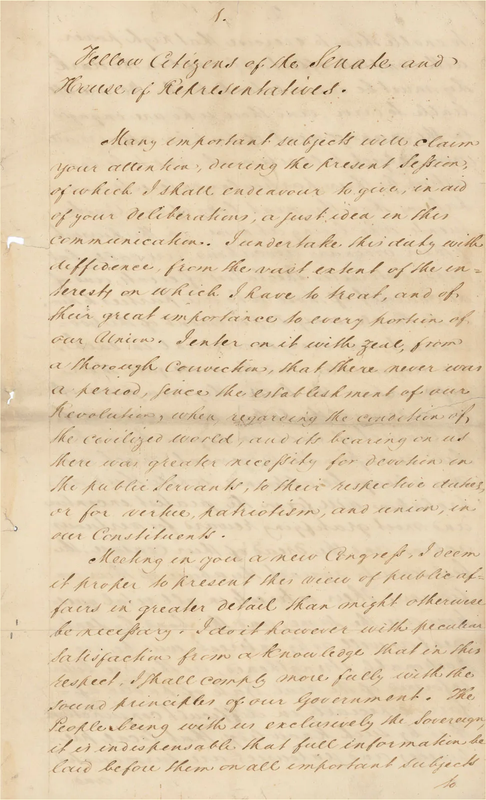
The [Monroe Doctrine](https://archive.ph/xRno0) was a cornerstone of U.S. foreign policy enunciated by Pres. James Monroe in his annual message to Congress.
Declaring that the Old World and New World had different systems and must remain distinct spheres, Monroe made four basic points:
1. The United States would not interfere in the internal affairs of or the wars between European powers;
2. The United States recognized and would not interfere with existing colonies and dependencies in the Western Hemisphere;
3. The Western Hemisphere was closed to future colonization; and
4. Any attempt by a European power to oppress or control any nation in the Western Hemisphere would be viewed as a hostile act against the United States:
> In the wars of the European powers in matters relating to themselves we have never taken any part, nor does it comport with our policy so to do. It is only when our rights are invaded or seriously menaced that we resent injuries or make preparation for our defense.…
>
> With the existing colonies or dependencies of any European power we have not interfered and shall not interfere. But with the governments who have declared their independence and maintained it, and whose independence we have, on great consideration and on just principles, acknowledged, we could not view any interposition for the purpose of oppressing them, or controlling in any other manner their destiny, by any European power in any other light than as the manifestation of an unfriendly disposition toward the United States.
#### Roosevelt Corollary
Date: 1904
The [Roosevelt Corollary](https://www.britannica.com/event/Roosevelt-Corollary) was a foreign policy declaration by U.S. Pres. Theodore Roosevelt in 1904–05 stating that, in cases of flagrant and chronic wrongdoing by a Latin American country, the United States could intervene in that country’s internal affairs.
(Assumed presidency in 1901 after McKinley's [assassination](https://www.pbs.org/crucible/tl20.html#:~:text=September%2014%2C%201901%3A%20President%20McKinley%20assassinated&text=On%20September%206%2C%201899%2C%20President,Czolgosz%20shot%20the%20President%20twice.) - side note — On September 6, 1899, President William McKinley was shot while on a speaking tour in Buffalo, New York.)
Roosevelt’s assertion of hemispheric police power was soon characterized as the Roosevelt Corollary to the Monroe Doctrine, though, in reality, it was a significant extension of that doctrine rather than an interpretation of it. Nevertheless, it was designed to preclude violation of the Monroe Doctrine by European countries seeking redress of grievances against unruly or mismanaged Latin American states.
In his annual message to Congress of 1904, Roosevelt announced the new Latin American policy that soon became known as the Roosevelt Corollary to the Monroe Doctrine: because that doctrine forbade European use of force in the New World, the United States would itself take whatever action was necessary to guarantee that Latin American states gave no cause for such European intervention. In his message to Congress the next year, Roosevelt detailed how the role of the United States as the international policeman for the Western Hemisphere would be carried out:
> It must be understood that under no circumstances will the United States use the Monroe Doctrine as a cloak for territorial aggression. We desire peace with all the world, but perhaps most of all with the other peoples of the American continent. There are, of course, limits to the wrongs which any self-respecting nation can endure.
>
> It is always possible that wrong actions toward this nation or toward citizens of this nation in some state unable to keep order among its own people, unable to secure justice from outsiders, and unwilling to do justice to those outsiders who treat it well, may result in our having to take action to protect our rights; but such action will not be taken with a view to territorial aggression, and it will be taken at all only with extreme reluctance and when it has become evident that every other resource has been exhausted.
The Roosevelt Corollary became closely associated with—and, for observers, synonymous with—Roosevelt’s **Big Stick policy**. Derived from his fondness for a West African proverb—“Speak softly and carry a big stick; you will go far”—that policy called for the assertion of U.S. domination when such dominance was considered a moral imperative.
Following his presidency, writing in Outlook magazine in 1914 about Belgium’s lack of preparedness for World War I, Roosevelt returned to the metaphor of the big stick:
> One of the main lessons to learn from this war is embodied in the homely proverb, “Speak softly and carry a big stick.” Persistently only half of this proverb has been quoted in deriding the men who wish to safeguard our national interest and honor. Persistently the effort has been made to insist that those who advocate keeping our country able to defend its rights are merely adopting ‘the policy of the big stick.’
>
> In reality, we lay equal emphasis on the fact that it is necessary to speak softly; in other words, that it is necessary to be respectful toward all people and scrupulously to refrain from wronging them, while at the same time keeping ourselves in condition to prevent wrong being done to us.
>
> If a nation does not in this sense speak softly, then sooner or later the policy of the big stick is certain to result in war. But what befell Luxembourg six weeks ago, what has befallen China again and again during the past quarter of a century shows that no amount of speaking softly will save any people which does not carry a big stick.
The idea is negotiating peacefully but also having strength in case things go wrong. Simultaneously threatening with the "[big stick](https://www.wikiwand.com/en/articles/Big_stick_ideology)", or the military, ties in heavily with the idea of [Realpolitik](https://www.wikiwand.com/en/articles/Realpolitik), which implies a pursuit of political power that resembles Machiavellian ("The ends justify the means") ideals. It is comparable to gunboat diplomacy, as used in international politics by the major powers.
**Political Cartoons:**

> William Allen Rogers's 1904 cartoon recreates the big-stick diplomacy of U.S. President Theodore Roosevelt as an episode in Gulliver's Travels.
#### Madman Theory
The [madman theory](https://www.wikiwand.com/en/articles/Madman_theory#See_also) is a political theory commonly associated with the foreign policy of U.S. president Richard Nixon and his administration, who tried to make the leaders of hostile communist bloc countries think Nixon was irrational and volatile so that they would avoid provoking the U.S. in fear of an unpredictable response.
The premise of madman theory is that it makes seemingly incredible threats seem credible. For instance, in an era of mutually assured destruction, threats by a rational leader to escalate a dispute may seem suicidal and thus easily dismissible by adversaries. However, a leader's suicidal threats may seem credible if the leader is believed to be irrational.
Date: Nixon Era (1969)
Nixon's chief of staff, H. R. Haldeman, wrote that Nixon had confided to him:
> I call it the Madman Theory, Bob. I want the North Vietnamese to believe I've reached the point where I might do anything to stop the war. We'll just slip the word to them that, "for God's sake, you know Nixon is obsessed about communism. We can't restrain him when he's angry—and he has his hand on the nuclear button" and Ho Chi Minh himself will be in Paris in two days begging for peace.
In October 1969, the Nixon administration indicated to the Soviet Union that "the madman was loose" when the United States military was ordered to full global war readiness alert known as the "Joint Chiefs of Staff Readiness Test" (unbeknownst to the majority of the American population), which culminated in the "Operation Giant Lance" when eighteen B-52 bombers armed with thermonuclear weapons flew patterns near the Soviet border for three consecutive days. - Article from 2005 '[Nixon's Madman Strategy](https://web.archive.org/web/20060116003053/http://www.boston.com/news/globe/editorial_opinion/oped/articles/2005/06/14/nixons_madman_strategy/)'
#### Brinksmanship
Brinksmanship is the practice of pushing a dangerous situation or confrontation to the limits of safety in order to force an advantageous outcome.
Date: 1953 - 1956
The term is chiefly associated with John Foster Dulles, US Secretary of State from 1953 to 1956 during the Eisenhower administration. Dulles sought to deter aggression by the Soviet Union by warning that the cost might be massive retaliation against Soviet targets. - [Excerpt](https://www.google.com/books/edition/Rise_to_Globalism/5lzMtwXckcEC?hl=en&gbpv=1&pg=PT109&printsec=frontcover)
#### Trump Era
Which combination is being used now? How potent are the threats behind the words and assured confrontation of deterrents of the US?
%%Footer Starts Here%%
---
![[Brain Icon 1.png|center]]
<b><font color="#ffffff"> <center>You might not have noticed it… but your brain did.</center> </font></b>
---
### Tags
### Linked Pages & Footnotes