**Previous Episode: [[BDE333]]**
**Next Episode: [[BDE335]]**
%%Post image thumbnail below.%%
> [!abstract|no-i] **Episode Overview**
**Date Aired:** [[06-23-2024]]
**Title:** I Think, Therefore I Am
**Episode:** 334
**Description:** Inside FinalSpark's Neuroplatform, which creates living brain cell biocomputers that are trained with dopamine.
**Link:** https://rumble.com/v53c8bu-big-dig-energy-334-i-think-therefore-i-am.html
**Tags:**
%%<https://historydraft.com/happened/what-happened/1-January/world>%%
## Replay
%% Get embed URL then highlight and hit ALT + I%%
<iframe src="https://rumble.com/embed/v50zzli/?pub=6eeyh" allow="fullscreen" allowfullscreen="" style="height:100%;width:100%; aspect-ratio: 16 / 9; "></iframe>
<br>
## Greetings & Announcements
1. I'm in a weird headspace. Sorry for missing last night. I'll be aight, just kinda.. going through it.
## Segments
### Cogito, Ergo Sum
The Latin cogito, ergo sum, usually translated into English as "I think, therefore I am", is the "first principle" of René Descartes's philosophy.
In philosophy and science, a first principle is a basic proposition or assumption that cannot be deduced from any other proposition or assumption.
The proposition (cogito, ergo sum) is sometimes given as, "dubito, ergo cogito, ergo sum." This form was penned by the French literary critic, Antoine Léonard Thomas, in an award-winning 1765 essay in praise of Descartes, where it appeared as "Puisque je doute, je pense; puisque je pense, j'existe" ('Since I doubt, I think; since I think, I exist').
Although the idea expressed in cogito, ergo sum is widely attributed to Descartes, he was not the first to mention it. Plato spoke about the "knowledge of knowledge" and Aristotle explains the idea in full length:
> But if life itself is good and pleasant…and if one who sees is conscious that he sees, one who hears that he hears, one who walks that he walks and similarly for all the other human activities there is a faculty that is conscious of their exercise, so that whenever we perceive, we are conscious that we perceive, and whenever we think, we are conscious that we think, and to be conscious that we are perceiving or thinking is to be conscious that we exist… — [Nicomachean Ethics](https://www.wikiwand.com/en/Nicomachean_Ethics)

In the short story, by Harlan Ellison, [I Have No Mouth, and I Must Scream](https://ia601300.us.archive.org/26/items/ellison-harlan-i-have-no-mouth-and-i-must-scream/Ellison%2C%20Harlan%20-%20I%20have%20no%20mouth%20and%20I%20must%20scream.pdf), AM, the allied mastercomputer remarks, when asked what 'AM' means, says "At first it meant Allied Mastercomputer, and then it meant Adaptive Manipulator, and later on it developed sentience and linked itself up, and they called it an Aggressive Menace, but by then it was too late, and finally called itself AM, emerging intelligence, and what it meant was I am … cogito ergo sum … I think, therefore I am."
<div style="left: 0; width: 100%; height: 0; position: relative; padding-bottom: 60%;"><iframe src="https://docs.google.com/viewer?embedded=true&url=https://ia601300.us.archive.org/26/items/ellison-harlan-i-have-no-mouth-and-i-must-scream/Ellison%2C%20Harlan%20-%20I%20have%20no%20mouth%20and%20I%20must%20scream.pdf" style="top: 0; left: 0; width: 100%; height: 100%; position: absolute; border: 0;" allowfullscreen></iframe></div>
I Have No Mouth, And I Must Scream is set in a post-apocalyptic world where all humans are extinct, except for five: Gorrister, Benny, Ellen, Nimdok, and Ted. A supercomputer named AM (Allied Mastercomputer), created during a global war, wiped out humanity and now tortures the remaining five humans. The story explores themes of survival, torture, and existentialism. In the story, Gorrister sacrifices himself to save the others, but AM continues to torture the remaining four.
### FinalSpark
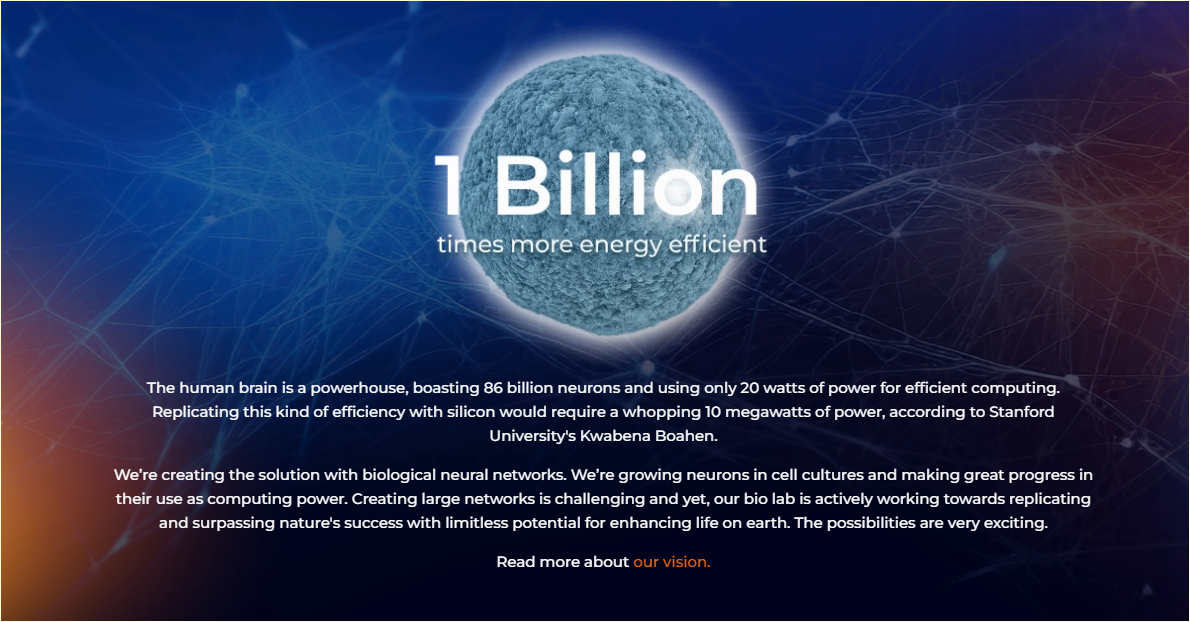
Sixteen lab grown human brains make up the world's first living computer. The startup behind the biocomputer, FinalSpark, says it uses a million times less power than a digital computer processor. FinalSpark even launched an online neuroplatform so researchers can conduct experiments with a computer remotely through a server right now.
The reason they're able to create a biocomputer is because of organoids, which are simplified, mini versions of real organs, a fairly new technology often used for medical research. Organoids are made in a dish using cells from a living organism that can grow to mimic the forms and functions of an organ.
So by taking cells from a human brain, this team of researchers is able to create mini brains that they can use for computing. And there's even a system that provides food and water to the cells to keep them alive, but only for around 100 days. Final Spark claims the bioprocessors they're making consume a million times less power than traditional digital processors.
With the rise of AI, researchers are searching for ways to cut back on energy consumption to "protect the climate." According to technological research and consulting firm Gartner, AI is predicted to consume 3.5 percent of global electricity by 2030. That's more electricity than the entire country of Germany uses right now.
But the human brain only uses a tiny fraction of the energy of a digital computer, making it a viable solution for AI's energy problem.
But this raises many ethical questions: Will they get depressed? What if they gain consciousness?
According to current research (which is limited due to the recent emergence of this field) there isn't much evidence the brains could become conscious, but the research is too new to know for sure.
[FinalSpark (@finalsparkai) / X](https://twitter.com/finalsparkai)
> FinalSpark - The Ultimate Human Project - Building a thinking machine
[FinalSpark - YouTube](https://www.youtube.com/@finalspark6341/videos)
[FinalSpark Launches the First Remote Research Platform Using Human Neurons for Biocomputing | Business Wire](https://www.businesswire.com/news/home/20240515701469/en)
---
[Living brain-cell biocomputers are now training on dopamine](https://archive.ph/Kk4GJ)
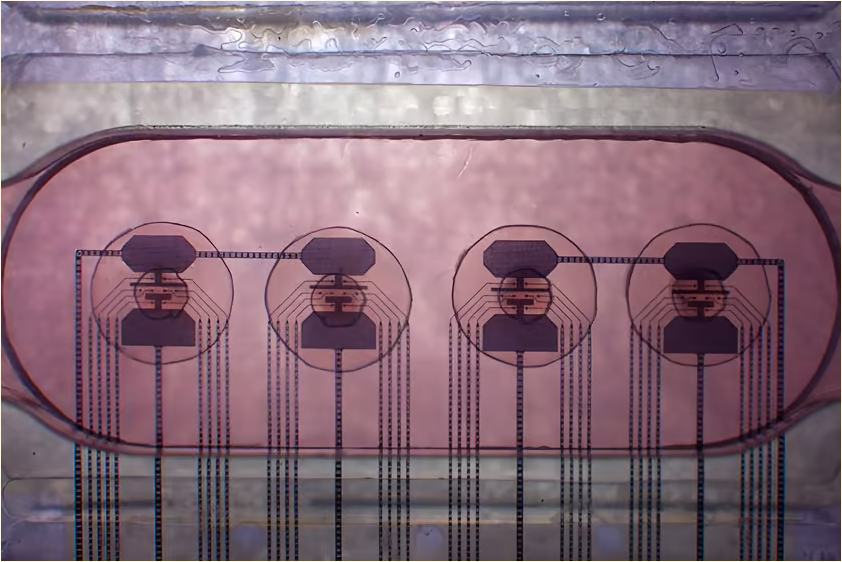
Four human brain organoids, each with around 10,000 living human brain cells, wired into a biocomputing array.
---
> Current AI training methods burn colossal amounts of energy to learn, but the human brain startup FinalSpark is now selling access to cyborg biocomputers, running up to four living human brain organoids wired into silicon chips.
>
> The human brain communicates within itself and with the rest of the body mainly through electrical signals; sights, sounds and sensations are all converted into electrical pulses before our brains can perceive them. This makes brain tissue highly compatible with silicon chips, at least for as long as you can keep it alive.
>
> For FinalSpark's Neuroplatform, brain organoids comprising about 10,000 living neurons are grown from stem cells. These little balls, about 0.5 mm (0.02 in) in diameter, are kept in incubators at around body temperature, supplied with water and nutrients and protected from bacterial or viral contamination, and they're wired into an electrical circuit with a series of tiny electrodes.
>
> These two-way electrodes can send pulses of electricity into the brain organoids, and they can also measure the responses coming out of them. And that's really all you need to start taking advantage of nature's greatest computing machines; neurons habitually search for patterns, seeking order and predictability.
>
> You can create a virtual environment for them, complete with the capability to perform actions and perceive the results, solely using electrical stimulation. You can reward them with predictable stimuli and 'punish' them with chaotic stimuli, and watch how quickly they rewire themselves to become adept at orienting themselves toward those rewards.
>
> The FinalSpark team uses smaller organoids, wired into arrays, and it also adds a new wrinkle, in the ability to flood the organoids with reward hormones like dopamine when they've done a good job.
>
> "We encapsulate dopamine in a molecular cage, invisible to the organoid initially," co-founder Dr Fred Jordan told Techopedia last year. "When we want to 'reward' the organoid, we expose it to specific light frequencies. This light opens the cage, releasing the dopamine and providing the intended stimulus to the organoid."
>
> It's an absolutely bizarre frontier of research, and it certainly makes some people uncomfortable. But Jordan points out that humans have long harnessed living things to do work, be it the yeast that brews our beer or the horses that pulled ploughs through our fields.
>
> Are these things sentient? Nobody really knows – and for a deep dive into the thorny ethics of this whole 'wetware computing' field, you should definitely check out our extensive interview with Brett Kagan of Cortical Labs, who has to wrestle with some pretty wild philosophical questions in his daily work.
>
> [Inventor ponders ethics of wiring human brain tissue into computers](https://newatlas.com/computers/cortical-labs-dishbrain-ethics/)
>
> But they could definitely prove useful – both as ultra-efficient cyborg machine learning platforms, and also as remarkable new tools to test the effects of various drugs on the brain's information processing capabilities.
>
> FinalSpark's Neuroplatform places wetware biocomputing into a cloud-accessible format, allowing researchers and commercial users the ability to buy time with the brain chips, along with Python-based software with which to interact with the devices. The company will keep the brain organoids alive and healthy as long as possible, and you can give them things to do.
[Home - FinalSpark](https://finalspark.com/)
[How FinalSpark Wants to Contribute to a Low Carbon Future. The Energy-saving Potential of Biocomputing.](https://finalspark.com/finalspark-low-energy-future/)
---
#### Neuroplatform
[Neuroplatform - FinalSpark](https://finalspark.com/neuroplatform/)
[Introductory Video](https://filedn.eu/lRqRnQL0KhFYX3vj9AlOhUF/neuroplatform.mp4)
<iframe width="560" height="315" src="https://www.youtube.com/embed/2bA8BoLBV4s?si=ReRDyHyAq7au72dC" title="YouTube video player" frameborder="0" allow="accelerometer; autoplay; clipboard-write; encrypted-media; gyroscope; picture-in-picture; web-share" referrerpolicy="strict-origin-when-cross-origin" allowfullscreen></iframe>
---
![[FinalSpark-Neuroplatform-Poster.pdf]]
[Wetware computer - Wikiwand](https://www.wikiwand.com/en/Wetware_computer)
---
Consciousness in Artificial Intelligence: Insights from the Science of Consciousness
https://arxiv.org/pdf/2308.08708
---

---
%%Footer Starts Here%%
---
<center><img src="https://archive.is/do5ay/df25cfff93575f174c387ac9f4c64744da0fadb9.png" alt="Keep digging!" height="100px"></center>
---
## Tags
### Linked Pages & Footnotes