# Red Pill or Blue Pill?
The Matrix is the 1999 sci-fi film that has become an endless source of inspiration for thought projects, but ultimately the reality of that movie have been rather far off… until now.

[The Matrix Script](https://www.dailyscript.com/scripts/the_matrix.pdf)
<div style="left: 0; width: 100%; height: 0; position: relative; padding-bottom: 60%;"><iframe src="https://docs.google.com/viewer?embedded=true&url=https://www.dailyscript.com/scripts/the_matrix.pdf" style="top: 0; left: 0; width: 100%; height: 100%; position: absolute; border: 0;" allowfullscreen></iframe></div>
## The Scene
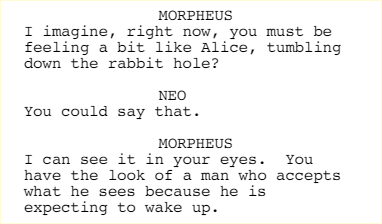
- 
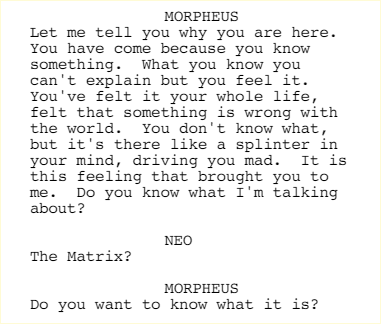
- 
<br>
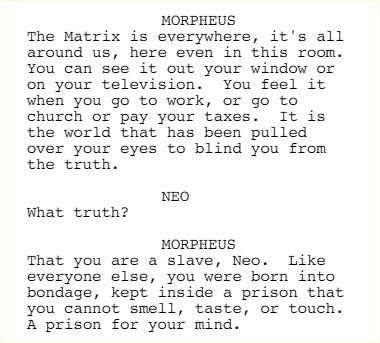
- 
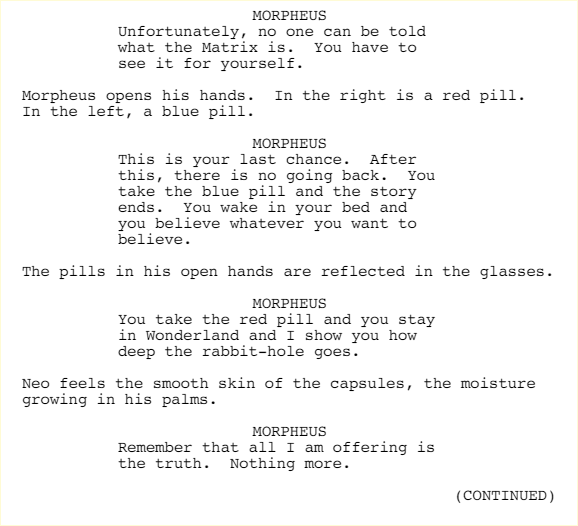
- 
> [!quote] Morpheus
> <p style="font-size:125%"><font color="#ffffff"> You are a slave, Neo. Like everyone else, you were born into bondage. Born into a prison that you cannot smell, or taste, or touch. A prison… for your mind. </font></p>
Fun Fact: Originally, the plan was for Will Smith to play Neo and for Val Kilmer to play Morpheus. Will Smith turned down the role to act in the movie Wild Wild West.
### The Red Pill
Neo takes the red pill, and comes to in a pod where he and countless others are being kept.
Eventually, he and Morpheus have another conversation:
![[What is The Matrix_ _ The Matrix [Open Matte].mp4]]
MORPHEUS: We have only bits and pieces of information. What we know for certain is that, at some point in the early Twenty-first Century, all of mankind was united in celebration. Through the blinding inebriation of hubris, we marveled at our magnificence as we gave birth to A.I.
NEO: A.I.? You mean artificial intelligence?
MORPHEUS: Yes. A singular consciousness that spawned an entire race of machines. I must say I find it almost funny to imagine the world slapping itself on the back, toasting the new age. I say almost funny.
MORPHEUS: We don't know who struck first. Us or them. But we do know it was us that scorched the sky. At the time, they were dependent on solar power. It was believed they would be unable to survive without an energy source as abundant as the sun.
MORPHEUS: Throughout human history, we have been dependent on machines to survive. Fate, it seems, is not without a sense of irony.
MORPHEUS: The Machines discovered a new form of fusion. All they needed was a small electrical charge to initiate the reaction.
MORPHEUS: The human body generates more bioelectricity than a 120-volt battery and over 25,000 B.T.U.'s of body heat.
MORPHEUS: There are fields, endless fields where human beings are no longer born; we are grown.
---
# Cogito, Ergo Sum
The Latin *cogito, ergo sum*, usually translated into English as "I think, therefore I am", is the "first principle" of René Descartes's philosophy. A first principle is a basic proposition or assumption that cannot be deduced from any other proposition or assumption. An Axiom, or "atomic truth."
The proposition (cogito, ergo sum) is sometimes given as, "dubito, ergo cogito, ergo sum." — *'Since I doubt, I think; since I think, I exist.'*
Defining, or attempting to define both the limits and the most basic building blocks of life, reality, and thought, is the heartbeat of many philosophical endeavors, reaching far beyond the likes of Plato, Aristotle, or Descartes.
One of my favorite philosophical works was published in 1921, written by an Austrian philosopher Ludwig Wittgenstein, titled ***Tractatus Logico-Philosophicus.***
The project had a broad goal: to identify the relationship between language and reality and to define the limits of science.
The Tractatus is written in an austere and succinct literary style, containing almost no arguments as such, but consists of altogether 525 declarative statements, which are hierarchically numbered.

Atomic sentences are of particular interest in philosophical logic and the theory of truth and, it has been argued, there are corresponding **atomic facts**.
[Full Text](https://www.gutenberg.org/files/5740/5740-pdf.pdf)
<div style="left: 0; width: 100%; height: 0; position: relative; padding-bottom: 60%;"><iframe src="https://docs.google.com/viewer?embedded=true&url=https://www.gutenberg.org/files/5740/5740-pdf.pdf" style="top: 0; left: 0; width: 100%; height: 100%; position: absolute; border: 0;" allowfullscreen></iframe></div>
Wittgenstein compared linguistic expression to projection in geometry. A geometrical figure may be projected in many ways, as can the proposed axioms.
---
# What Are You Talking About?
All of this buildup, explanation of basic parts of philosophy, a reminder of the plot of the Matrix movie, is to present to you the next digital frontier. And it's one that is so alarming and so bereft of consideration for the gravity of which it proposes, that I wanted to remind you of how we should proceed:
We seek the atomic truths, we string them together. We draw parallels to previous examples in movies and art to flesh out the full picture.
## Man-made Horrors Beyond Your Comprehension
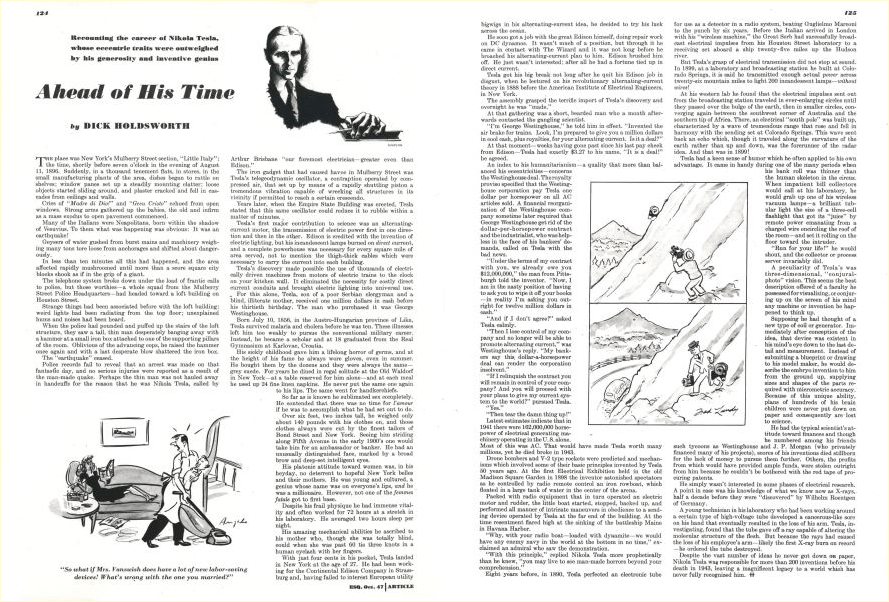
It was at the first ever Electrical Exhibition at Madison Square Garden in the year 1898 that Nikolai Tesla, the pioneer of alternating current electricity, "astonished spectators as he controlled by radio remote control an iron rowboat, which floated in a large tank of water in the center of the arena.
Packed with radio equipment that in turn operated an electric motor and rudder, the little boat started, stopped, backed up, and performed all manner of intricate maneuvers in obedience to a sending device operated by Tesla at the far end of the building. At the time resentment flared high at the sinking of the battleship Maine in Havana Harbor.
"Why, with your radio boat - loaded with dynamite - we would have any enemy navy in the world at the bottom in no time," exclaimed an admiral who saw the demonstration.
"With this principle," replied Nikola Tesla more prophetically than he knew, "you may live to see man-made horrors beyond your comprehension." — [Ahead of His Time; Esquire; 1947](https://archive.ph/poZit)
Prophetic indeed. First, [we visit](https://x.com/newscientist/status/1805652025125859665):

[Smiling robot face is made from living human skin cells | New Scientist](https://www.newscientist.com/article/2436859-smiling-robot-face-is-made-from-living-human-skin-cells/)
> A smiling face made from living human skin could one day be attached to a humanoid robot, allowing machines to emote and communicate in a more life-like way, say researchers. Its wrinkles could also prove useful for the cosmetics industry.
>
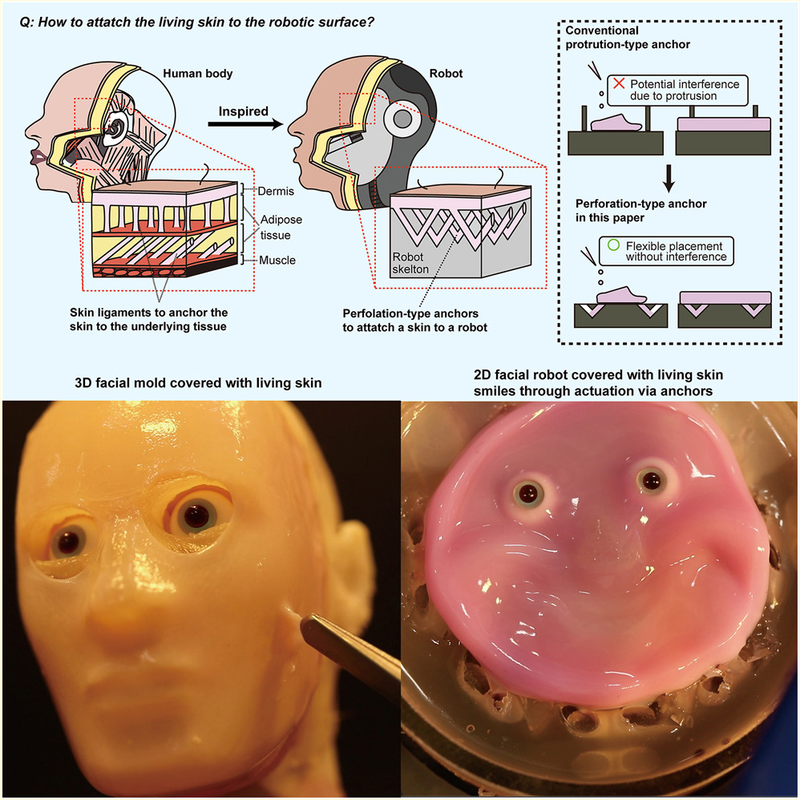
> The living tissue is a cultured mix of human skin cells grown in a collagen scaffold and placed on top of a 3D-printed resin base. Unlike previous similar experiments, the skin also contains the equivalent of the ligaments that, in humans and other animals, are buried in the layer of tissue beneath the skin, holding it in place and giving it incredible strength and flexibility.
- **See: [Scientists covered a robot finger in living human skin | New Scientist](https://www.newscientist.com/article/2323290-scientists-covered-a-robot-finger-in-living-human-skin/)**
> Michio Kawai at Harvard University and his colleagues call these ligament equivalents "perforation-type anchors" because they were created by perforating the robot's resin base and allowing tiny v-shaped cavities to fill with living tissue. This, in turn, helps the robot skin stay in place.
>
> The team put the skin on a smiling robotic face, a few centimetres wide, which is moved by rods connected to the base. It was also attached to a similarly sized 3D shape in the form of a human head (see below), but this couldn't move.
**"As the development of AI technology and other advancements expand the roles required of robots, the functions required of robot skin are also beginning to change," says Kawai, adding that a human-like skin could help robots communicate with people better.**
> The work could also have surprising benefits for the cosmetics industry. In an experiment, the researchers made the small robot face smile for one month, finding they could replicate the formation of expression wrinkles in the skin, says Kawai.
>
> "Being able to recreate wrinkle formation on a palm-sized laboratory chip can simultaneously be used to test new cosmetics and skincare products that aim to prevent, delay or improve wrinkle formation," says Kawai, who performed the work while at the University of Tokyo.
>
> Of course, the skin still lacks some of the functions and durability of real skin, says Kawai.
**"The lack of sensing functions and the absence of blood vessels to supply nutrients and moisture means it cannot survive long in the air," he says. "To address these issues, incorporating <u>neural mechanisms</u> and perfusion channels into the skin tissue is the current challenge."**
---
### DOI Paper

https://www.cell.com/cell-reports-physical-science/fulltext/S2666-3864(24)00335-7
> Skin equivalent, a living skin model composed of cells and extracellular matrix, possesses the potential to be an ideal covering material for robots due to its biological functionalities. To employ skin equivalents as covering materials for robots, a secure method for attaching them to the underlying structure is required. In this study, we develop and characterize perforation-type anchors inspired by the structure of skin ligaments as a technique to effectively adhere skin equivalents to robotic surfaces. To showcase the versatility of perforation-type anchors in three-dimensional (3D) coverage applications, we cover a 3D facial mold with intricate surface structure with skin equivalent using perforation-type anchors. Furthermore, we construct a robotic face covered with dermis equivalent, capable of expressing smiles, with actuation through perforation-type anchors. With the above results, this research introduces an approach to adhere and actuate skin equivalents with perforation-type anchors, potentially contributing to advancements in biohybrid robotics.
---
[Co-culture system of human skin equivalents with mouse neural spheroids](https://www.sciencedirect.com/science/article/abs/pii/S138917232300141X?via%3Dihub)
This study describes a co-culture system of human skin equivalents (HSEs) and **<u>dorsal root ganglion (DRG) neurons</u>**. We prepared spheroids of mouse DRG neurons with or without Schwann cells (SCs). Spheroids comprising DRG neurons and SCs showed longer neurite extensions than those comprising DRG neurons alone. Neurite extension of more than 1 mm was observed from spheroids cultured inside HSEs, whereas neurite extension was primarily observed on the surface of HSEs from spheroids cultured on HSEs. We propose that our model may be a useful tool for studying neurite extension in the human skin.
---
# Harlan Ellison
In the short story, by Harlan Ellison, [I Have No Mouth, and I Must Scream](https://ia601300.us.archive.org/26/items/ellison-harlan-i-have-no-mouth-and-i-must-scream/Ellison%2C%20Harlan%20-%20I%20have%20no%20mouth%20and%20I%20must%20scream.pdf), AM, the allied mastercomputer remarks, when asked what 'AM' means, says "At first it meant Allied Mastercomputer, and then it meant Adaptive Manipulator, and later on it developed sentience and linked itself up, and they called it an Aggressive Menace, but by then it was too late, and finally called itself AM, emerging intelligence, and what it meant was I am … cogito ergo sum … I think, therefore I am."
<div style="left: 0; width: 100%; height: 0; position: relative; padding-bottom: 60%;"><iframe src="https://docs.google.com/viewer?embedded=true&url=https://ia601300.us.archive.org/26/items/ellison-harlan-i-have-no-mouth-and-i-must-scream/Ellison%2C%20Harlan%20-%20I%20have%20no%20mouth%20and%20I%20must%20scream.pdf" style="top: 0; left: 0; width: 100%; height: 100%; position: absolute; border: 0;" allowfullscreen></iframe></div>
I Have No Mouth, And I Must Scream is set in a post-apocalyptic world where all humans are extinct, except for five: Gorrister, Benny, Ellen, Nimdok, and Ted. A supercomputer named AM (Allied Mastercomputer), created during a global war, wiped out humanity and now tortures the remaining five humans. The story explores themes of survival, torture, and existentialism. In the story, Gorrister sacrifices himself to save the others and is left as essentially a sentient blob, to be tortured by AM forever.
---
# FinalSpark
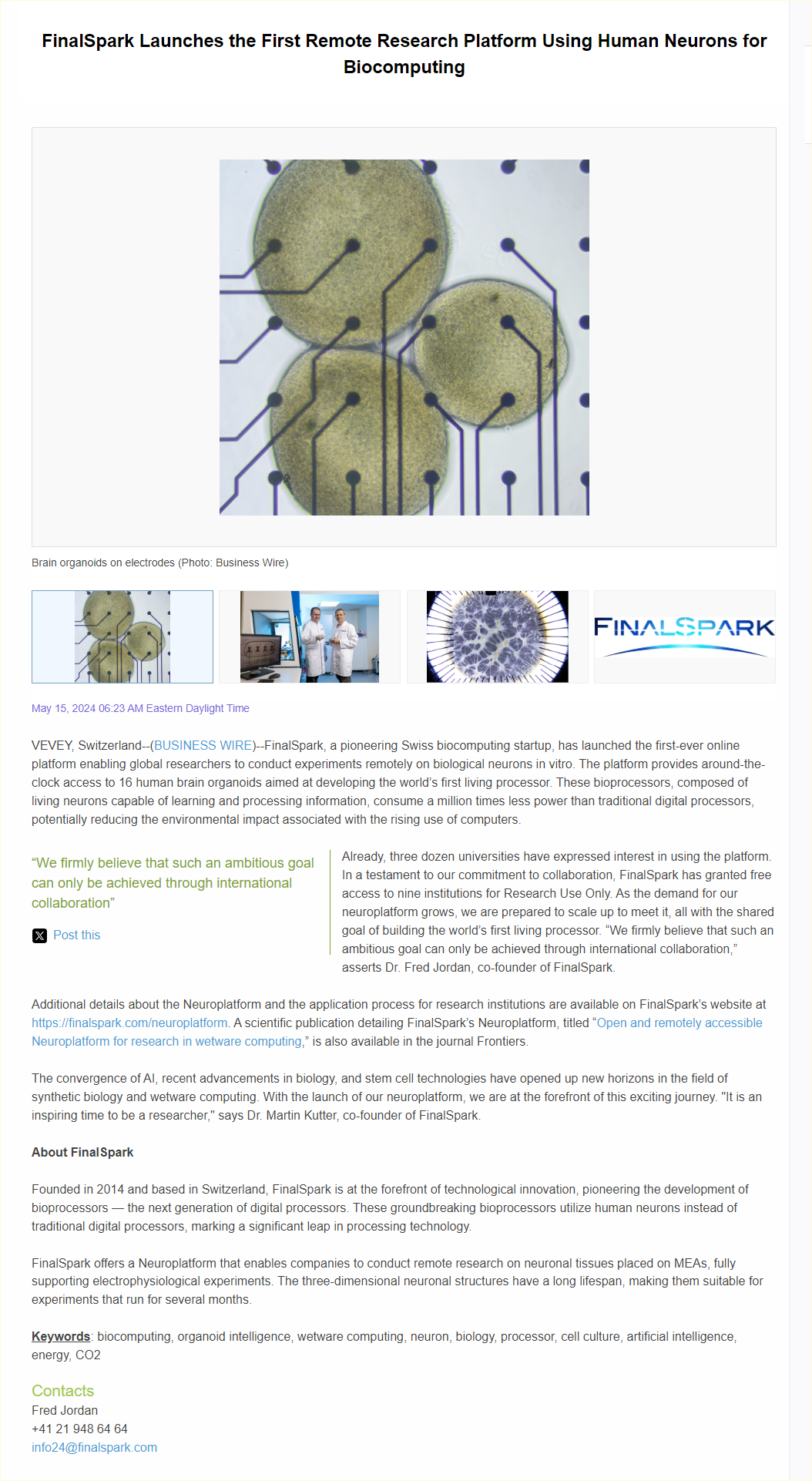
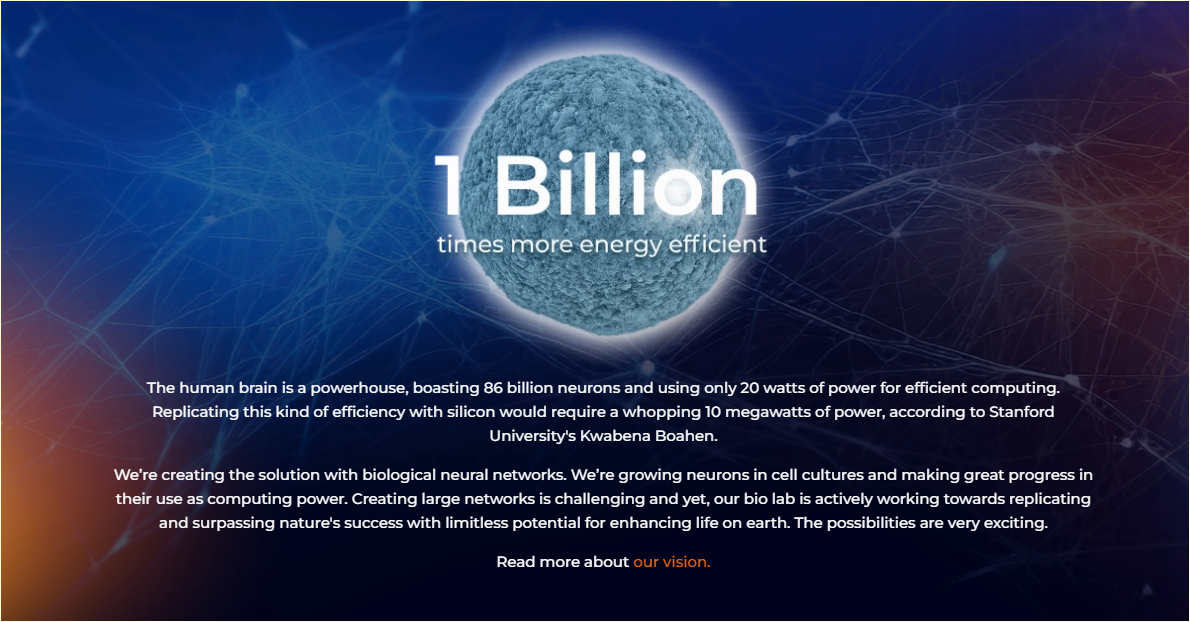
Sixteen lab grown human brains make up the world's first living computer. The startup behind the biocomputer, FinalSpark, says it uses a million times less power than a digital computer processor. FinalSpark even launched an online neuroplatform so researchers can conduct experiments with a computer remotely through a server right now.
The reason they're able to create a biocomputer is because of organoids, which are simplified, mini versions of real organs, a fairly new technology often used for medical research. Organoids are made in a dish using cells from a living organism that can grow to mimic the forms and functions of an organ.
So by taking cells from a human brain, this team of researchers is able to create mini brains that they can use for computing. And there's even a system that provides food and water to the cells to keep them alive, but only for around 100 days. Final Spark claims the bioprocessors they're making consume a million times less power than traditional digital processors.
With the rise of AI, researchers are searching for ways to cut back on energy consumption to "protect the climate." According to technological research and consulting firm Gartner, AI is predicted to consume 3.5 percent of global electricity by 2030. That's more electricity than the entire country of Germany uses right now.
But the human brain only uses a tiny fraction of the energy of a digital computer, making it a viable solution for AI's energy problem.
But this raises many ethical questions: Will they get depressed? What if they gain consciousness?
According to current research (which is limited due to the recent emergence of this field) there isn't much evidence the brains could become conscious, but the research is too new to know for sure.
[FinalSpark (@finalsparkai) / X](https://twitter.com/finalsparkai)
> FinalSpark - The Ultimate Human Project - Building a thinking machine
[FinalSpark - YouTube](https://www.youtube.com/@finalspark6341/videos)
---
[FinalSpark Launches the First Remote Research Platform Using Human Neurons for Biocomputing | Business Wire](https://www.businesswire.com/news/home/20240515701469/en)
---
[Living brain-cell biocomputers are now training on dopamine](https://archive.ph/Kk4GJ)
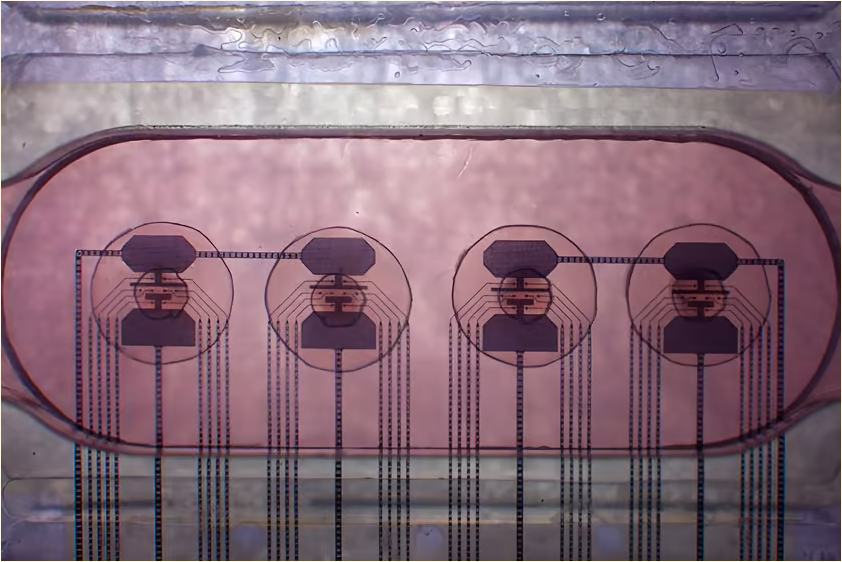
Four human brain organoids, each with around 10,000 living human brain cells, wired into a biocomputing array.
---
> Current AI training methods burn colossal amounts of energy to learn, but the human brain startup FinalSpark is now selling access to cyborg biocomputers, running up to four living human brain organoids wired into silicon chips.
>
> The human brain communicates within itself and with the rest of the body mainly through electrical signals; sights, sounds and sensations are all converted into electrical pulses before our brains can perceive them. This makes brain tissue highly compatible with silicon chips, at least for as long as you can keep it alive.
>
> For FinalSpark's Neuroplatform, brain organoids comprising about 10,000 living neurons are grown from stem cells. These little balls, about 0.5 mm (0.02 in) in diameter, are kept in incubators at around body temperature, supplied with water and nutrients and protected from bacterial or viral contamination, and they're wired into an electrical circuit with a series of tiny electrodes.
>
> These two-way electrodes can send pulses of electricity into the brain organoids, and they can also measure the responses coming out of them. And that's really all you need to start taking advantage of nature's greatest computing machines; neurons habitually search for patterns, seeking order and predictability.
>
> You can create a virtual environment for them, complete with the capability to perform actions and perceive the results, solely using electrical stimulation. You can reward them with predictable stimuli and 'punish' them with chaotic stimuli, and watch how quickly they rewire themselves to become adept at orienting themselves toward those rewards.
>
> The FinalSpark team uses smaller organoids, wired into arrays, and it also adds a new wrinkle, in the ability to flood the organoids with reward hormones like dopamine when they've done a good job.
>
> "We encapsulate dopamine in a molecular cage, invisible to the organoid initially," co-founder Dr Fred Jordan told Techopedia last year. "When we want to 'reward' the organoid, we expose it to specific light frequencies. This light opens the cage, releasing the dopamine and providing the intended stimulus to the organoid."
>
> It's an absolutely bizarre frontier of research, and it certainly makes some people uncomfortable. But Jordan points out that humans have long harnessed living things to do work, be it the yeast that brews our beer or the horses that pulled ploughs through our fields.
>
> Are these things sentient? Nobody really knows – and for a deep dive into the thorny ethics of this whole 'wetware computing' field, you should definitely check out our extensive interview with Brett Kagan of Cortical Labs, who has to wrestle with some pretty wild philosophical questions in his daily work.
>
> [Inventor ponders ethics of wiring human brain tissue into computers](https://newatlas.com/computers/cortical-labs-dishbrain-ethics/)
>
> But they could definitely prove useful – both as ultra-efficient cyborg machine learning platforms, and also as remarkable new tools to test the effects of various drugs on the brain's information processing capabilities.
>
> FinalSpark's Neuroplatform places wetware biocomputing into a cloud-accessible format, allowing researchers and commercial users the ability to buy time with the brain chips, along with Python-based software with which to interact with the devices. The company will keep the brain organoids alive and healthy as long as possible, and you can give them things to do.
[Home - FinalSpark](https://finalspark.com/)
[How FinalSpark Wants to Contribute to a Low Carbon Future. The Energy-saving Potential of Biocomputing.](https://finalspark.com/finalspark-low-energy-future/)
---
#### Neuroplatform
[Neuroplatform - FinalSpark](https://finalspark.com/neuroplatform/)
[Introductory Video](https://filedn.eu/lRqRnQL0KhFYX3vj9AlOhUF/neuroplatform.mp4)
<iframe width="560" height="315" src="https://www.youtube.com/embed/2bA8BoLBV4s?si=ReRDyHyAq7au72dC" title="YouTube video player" frameborder="0" allow="accelerometer; autoplay; clipboard-write; encrypted-media; gyroscope; picture-in-picture; web-share" referrerpolicy="strict-origin-when-cross-origin" allowfullscreen></iframe>
---
![[FinalSpark-Neuroplatform-Poster-1.png]]
---
[Wetware computer - Wikiwand](https://www.wikiwand.com/en/Wetware_computer)
---
Consciousness in Artificial Intelligence: Insights from the Science of Consciousness
https://arxiv.org/pdf/2308.08708
---

---
['Brain-in-a-jar' biocomputers can now learn to control robots](https://newatlas.com/robotics/brain-organoid-robot/)
%%Footer Starts Here%%
---
<center><img src="https://archive.is/do5ay/df25cfff93575f174c387ac9f4c64744da0fadb9.png" alt="Keep digging!" height="100px"></center>
---
### Tags
### Linked Pages & Footnotes